use the image from part of the periodic table to answer the question. 5 b 6 c 7 n 8 o 13 al 14 si 15 p 16 s…
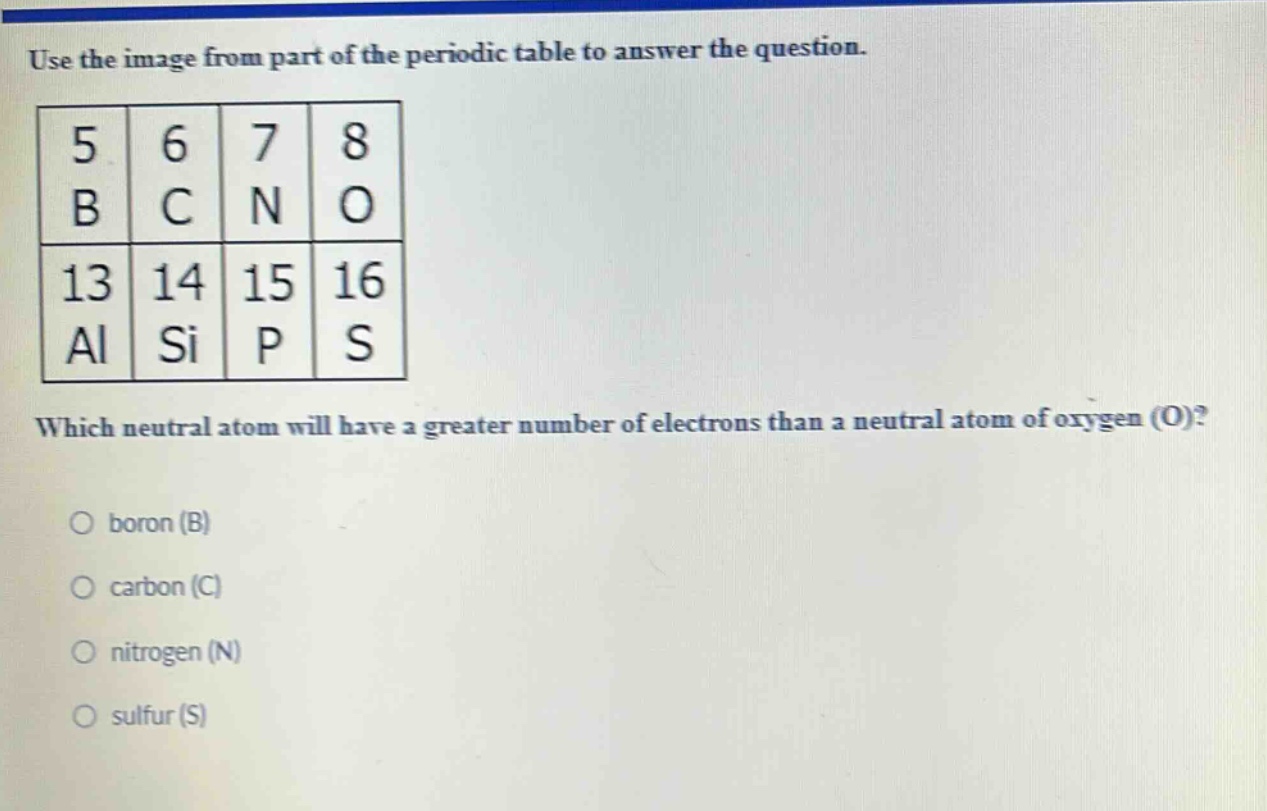
use the image from part of the periodic table to answer the question. 5 b 6 c 7 n 8 o 13 al 14 si 15 p 16 s which neutral atom will have a greater number of electrons than a neutral atom of oxygen (o)? boron (b) carbon (c) nitrogen (n) sulfur (s)
Answer
Explanation:
Step1: Recall electron - number rule for neutral atoms
In a neutral atom, the number of electrons is equal to the atomic number.
Step2: Determine oxygen's atomic number
Oxygen (O) has an atomic number of 8, so a neutral oxygen atom has 8 electrons.
Step3: Determine atomic numbers of other elements
Boron (B) has an atomic number of 5, carbon (C) has an atomic number of 6, nitrogen (N) has an atomic number of 7, and sulfur (S) has an atomic number of 16.
Step4: Compare atomic numbers
Since 16>8 and 5 < 8, 6 < 8, 7 < 8, sulfur (S) has more electrons than oxygen.
Answer:
Sulfur (S)