use the information to answer the following question. students are trying to calculate the heat of reaction…
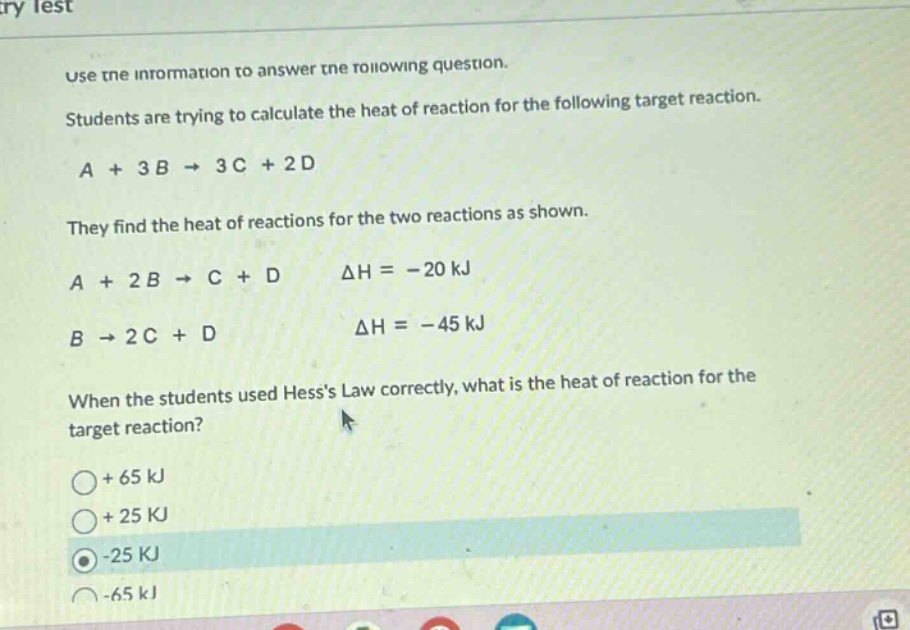
use the information to answer the following question. students are trying to calculate the heat of reaction for the following target reaction. a + 3b → 3c + 2d they find the heat of reactions for the two reactions as shown. a + 2b → c + d δh = -20 kj b → 2c + d δh = -45 kj when the students used hesss law correctly, what is the heat of reaction for the target reaction? + 65 kj + 25 kj -25 kj -65 kj
Answer
Explanation:
Step1: Identify the given reactions
Reaction 1: $A + 2B\rightarrow C + D$, $\Delta H_1=- 20\ kJ$ Reaction 2: $B\rightarrow2C + D$, $\Delta H_2=-45\ kJ$ Target reaction: $A + 3B\rightarrow3C + 2D$
Step2: Manipulate the given reactions
We can use Reaction 1 and Reaction 2 as they are. When we add Reaction 1 ($A + 2B\rightarrow C + D$) and Reaction 2 ($B\rightarrow2C + D$) together, the left - hand sides add up to $A+2B + B=A + 3B$ and the right - hand sides add up to $C + D+2C + D=3C + 2D$, which is the target reaction.
Step3: Calculate the heat of reaction for the target reaction
According to Hess's Law, $\Delta H_{target}=\Delta H_1+\Delta H_2$. Substitute $\Delta H_1=-20\ kJ$ and $\Delta H_2 = - 45\ kJ$ into the equation: $\Delta H_{target}=-20\ kJ+( - 45\ kJ)=-65\ kJ$
Answer:
-65 kJ