use the oxidation states as indicated by the superscript numbers to answer the questions.\nk^(+1)cl^(+5)o_3^(…
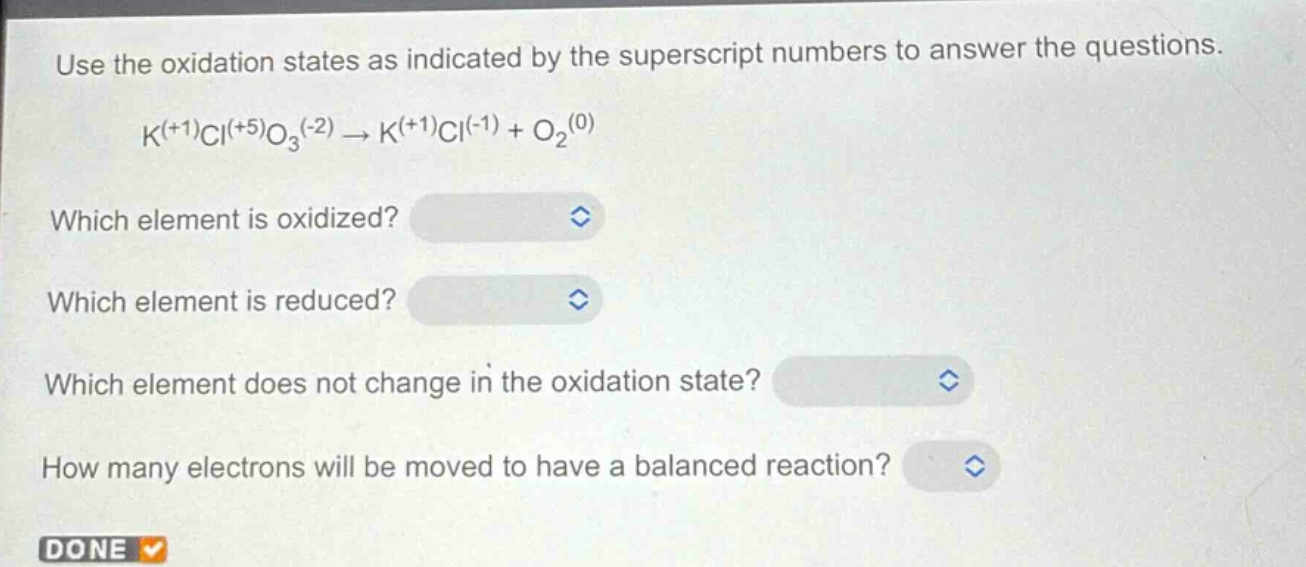
use the oxidation states as indicated by the superscript numbers to answer the questions.\nk^(+1)cl^(+5)o_3^(-2)→k^(+1)cl^(-1)+o_2^(0)\nwhich element is oxidized?\nwhich element is reduced?\nwhich element does not change in the oxidation state?\nhow many electrons will be moved to have a balanced reaction?
Answer
Explanation:
Step1: Define oxidation and reduction
Oxidation is increase in oxidation state, reduction is decrease.
Step2: Analyze oxidation - state changes
For the reaction $K^{( + 1)}Cl^{( + 5)}O_3^{( - 2)}\to K^{( + 1)}Cl^{( - 1)}+O_2^{(0)}$, oxygen goes from - 2 to 0 (oxidized), chlorine goes from + 5 to - 1 (reduced), potassium remains + 1 (no change).
Step3: Determine electron - transfer for balanced reaction
Chlorine gains 6 electrons ($+5-( - 1)=6$) and each oxygen atom loses 2 electrons. In $O_2$, 2 oxygen atoms lose a total of 4 electrons. To balance, find the least - common multiple of 4 and 6. The least - common multiple of 4 and 6 is 12. So 12 electrons are transferred in the balanced reaction.
Answer:
Which element is oxidized? Oxygen Which element is reduced? Chlorine Which element does not change in the oxidation state? Potassium How many electrons will be moved to have a balanced reaction? 12