use the periodic table to calculate the molar mass of each of the following compounds. each answer must have…
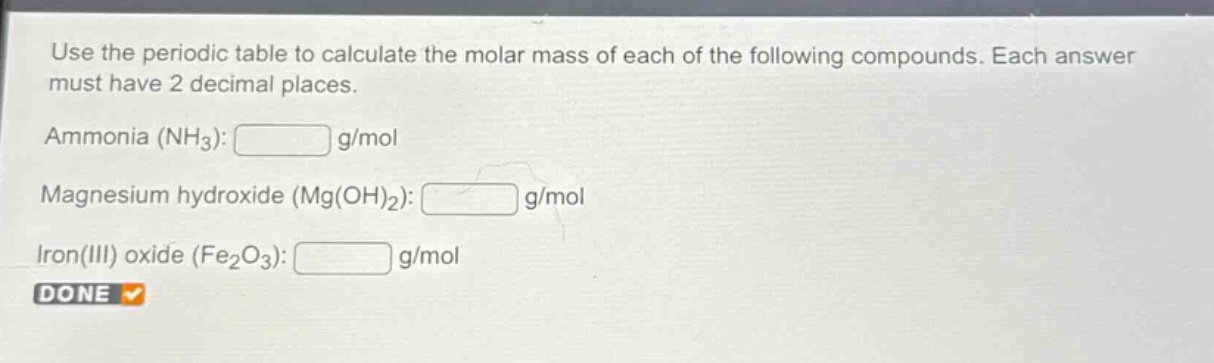
use the periodic table to calculate the molar mass of each of the following compounds. each answer must have 2 decimal places.\nammonia (nh₃): g/mol\nmagnesium hydroxide (mg(oh)₂): g/mol\niron(iii) oxide (fe₂o₃): g/mol\ndone
Answer
Explanation:
Step1: Find molar - mass of elements
From the periodic table, the molar mass of N is 14.01 g/mol, H is 1.01 g/mol, Mg is 24.31 g/mol, O is 16.00 g/mol, and Fe is 55.85 g/mol.
Step2: Calculate molar mass of NH₃
The formula for ammonia is NH₃. There is 1 N atom and 3 H atoms. So, $M_{NH_3}=1\times14.01 + 3\times1.01=14.01+3.03 = 17.04$ g/mol.
Step3: Calculate molar mass of Mg(OH)₂
For magnesium hydroxide Mg(OH)₂, there is 1 Mg atom, 2 O atoms, and 2 H atoms. So, $M_{Mg(OH)_2}=24.31+2\times16.00 + 2\times1.01=24.31 + 32.00+2.02=58.33$ g/mol.
Step4: Calculate molar mass of Fe₂O₃
For iron(III) oxide Fe₂O₃, there are 2 Fe atoms and 3 O atoms. So, $M_{Fe_2O_3}=2\times55.85+3\times16.00=111.70 + 48.00=159.70$ g/mol.
Answer:
Ammonia (NH₃): 17.04 g/mol Magnesium hydroxide (Mg(OH)₂): 58.33 g/mol Iron(III) oxide (Fe₂O₃): 159.70 g/mol