use the periodic table to compare the sizes of ionic radii with the corresponding atomic radii or other…
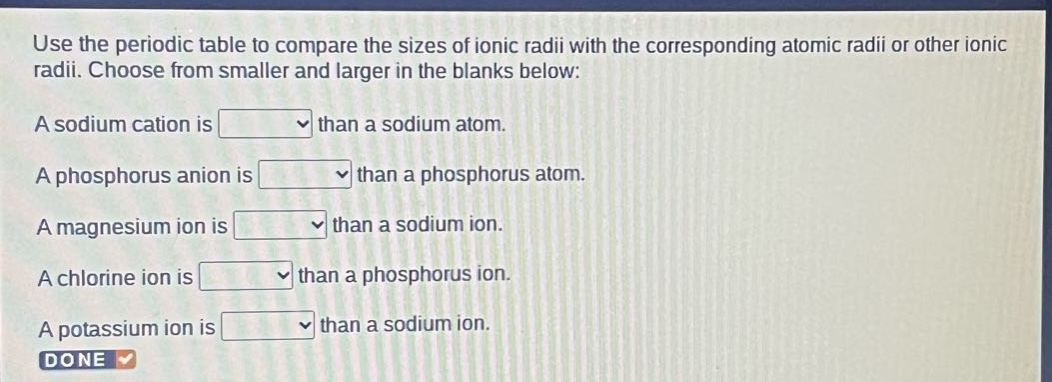
use the periodic table to compare the sizes of ionic radii with the corresponding atomic radii or other ionic radii. choose from smaller and larger in the blanks below: a sodium cation is than a sodium atom. a phosphorus anion is than a phosphorus atom. a magnesium ion is than a sodium ion. a chlorine ion is than a phosphorus ion. a potassium ion is than a sodium ion. done
Answer
Explanation:
Step1: Analyze sodium cation
A sodium cation ($Na^+$) forms when a sodium atom loses an electron. The out - most electron shell is removed, so the ionic radius is smaller.
Step2: Analyze phosphorus anion
A phosphorus anion ($P^{3 -}$) forms when a phosphorus atom gains 3 electrons. The increased electron - electron repulsion causes the electron cloud to expand, making the ionic radius larger.
Step3: Analyze magnesium and sodium ions
Magnesium ion ($Mg^{2+}$) and sodium ion ($Na^+$) are isoelectronic (have the same number of electrons). But magnesium has a higher nuclear charge (12 protons for Mg and 11 protons for Na). The greater nuclear charge in $Mg^{2+}$ pulls the electrons closer, so $Mg^{2+}$ is smaller.
Step4: Analyze chlorine and phosphorus ions
Chlorine ion ($Cl^-$) and phosphorus ion ($P^{3 -}$) are in the same period. $Cl^-$ has a higher nuclear charge (17 protons for Cl and 15 protons for P) and the same number of electron shells. The greater nuclear charge in $Cl^-$ pulls the electrons closer, so $Cl^-$ is smaller.
Step5: Analyze potassium and sodium ions
Potassium ion ($K^+$) has one more electron shell than sodium ion ($Na^+$). More electron shells mean a larger ionic radius, so $K^+$ is larger.
Answer:
- smaller
- larger
- smaller
- smaller
- larger