use the periodic table to find the charge of the ion that each atom is most likely to form. the charge of a…
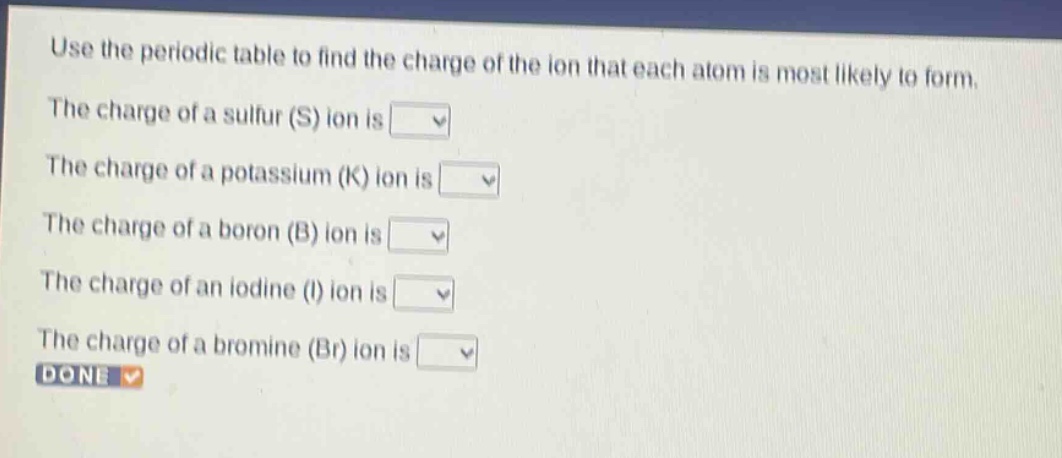
use the periodic table to find the charge of the ion that each atom is most likely to form. the charge of a sulfur (s) ion is the charge of a potassium (k) ion is the charge of a boron (b) ion is the charge of an iodine (i) ion is the charge of a bromine (br) ion is done
Answer
Explanation:
Step1: Analyze sulfur
Sulfur is in group 16. It gains 2 electrons to achieve a stable - octet. So the ion charge is - 2.
Step2: Analyze potassium
Potassium is in group 1. It loses 1 electron to achieve a stable - octet. So the ion charge is + 1.
Step3: Analyze boron
Boron is in group 13. It loses 3 electrons to achieve a stable - octet. So the ion charge is + 3.
Step4: Analyze iodine
Iodine is in group 17. It gains 1 electron to achieve a stable - octet. So the ion charge is - 1.
Step5: Analyze bromine
Bromine is in group 17. It gains 1 electron to achieve a stable - octet. So the ion charge is - 1.
Answer:
The charge of a sulfur (S) ion is - 2 The charge of a potassium (K) ion is + 1 The charge of a boron (B) ion is + 3 The charge of an iodine (I) ion is - 1 The charge of a bromine (Br) ion is - 1