use the periodic table to identify the element indicated by each electron configuration by typing in the…
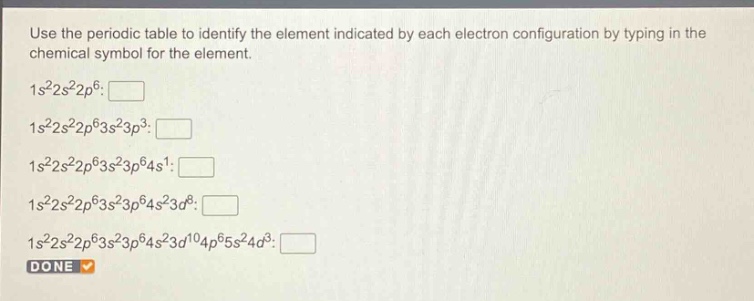
use the periodic table to identify the element indicated by each electron configuration by typing in the chemical symbol for the element. 1s²2s²2p⁶: 1s²2s²2p⁶3s²3p³: 1s²2s²2p⁶3s²3p⁶4s¹: 1s²2s²2p⁶3s²3p⁶4s²3d⁸: 1s²2s²2p⁶3s²3p⁶4s²3d¹⁰4p⁶5s²4d³: done
Answer
Explanation:
Step1: Determine number of electrons
The sum of the exponents in the electron - configuration gives the number of electrons. For a neutral atom, the number of electrons is equal to the atomic number.
Step2: Identify element for $1s^{2}2s^{2}2p^{6}$
The sum of the exponents is $2 + 2+6=10$. The element with atomic number 10 is Neon, symbol Ne.
Step3: Identify element for $1s^{2}2s^{2}2p^{6}3s^{2}3p^{3}$
The sum of the exponents is $2 + 2+6 + 2+3 = 15$. The element with atomic number 15 is Phosphorus, symbol P.
Step4: Identify element for $1s^{2}2s^{2}2p^{6}3s^{2}3p^{6}4s^{1}$
The sum of the exponents is $2 + 2+6 + 2+6 + 1=19$. The element with atomic number 19 is Potassium, symbol K.
Step5: Identify element for $1s^{2}2s^{2}2p^{6}3s^{2}3p^{6}4s^{2}3d^{8}$
The sum of the exponents is $2 + 2+6 + 2+6 + 2+8 = 28$. The element with atomic number 28 is Nickel, symbol Ni.
Step6: Identify element for $1s^{2}2s^{2}2p^{6}3s^{2}3p^{6}4s^{2}3d^{10}4p^{6}5s^{2}4d^{3}$
The sum of the exponents is $2 + 2+6 + 2+6 + 2+10 + 6+2 + 3=41$. The element with atomic number 41 is Niobium, symbol Nb.
Answer:
Ne P K Ni Nb