use the periodic table to identify each of the following bonds as polar or nonpolar.\nc—cl\npolar\nnonpolar\n…
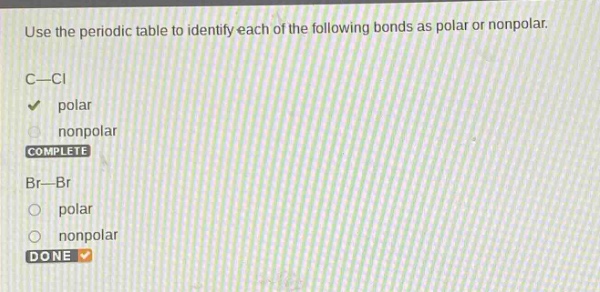
use the periodic table to identify each of the following bonds as polar or nonpolar.\nc—cl\npolar\nnonpolar\ncomplete\nbr—br\npolar\nnonpolar\ndone
Answer
Explanation:
Step1: Recall electronegativity concept
Electronegativity is the ability of an atom to attract electrons in a chemical bond. In a bond, if there is a significant difference in electronegativity between the two atoms, the bond is polar. If the electronegativity difference is zero or very small, the bond is non - polar.
Step2: Analyze C - Cl bond
Carbon (C) has an electronegativity of approximately 2.5 and chlorine (Cl) has an electronegativity of approximately 3.0. The electronegativity difference $\Delta\chi=3.0 - 2.5=0.5$. Since there is a non - zero electronegativity difference, the C - Cl bond is polar.
Step3: Analyze Br - Br bond
Bromine (Br) atoms in a Br - Br bond have the same electronegativity (both Br atoms have an electronegativity of approximately 2.8). The electronegativity difference $\Delta\chi = 2.8-2.8 = 0$. So, the Br - Br bond is non - polar.
Answer:
C—Cl: polar Br—Br: nonpolar