use the references to access important values if needed for this question. from the lewis structures of the…
use the references to access important values if needed for this question. from the lewis structures of the species given, pick all of those in which the central atom obeys the octet rule. none of the above
Answer
Explanation:
Step1: Define the Octet Rule
The octet rule states that atoms tend to bond in such a way that they each have eight electrons in their valence shell. We count 2 electrons for each bond and 2 electrons for each lone pair around the central atom.
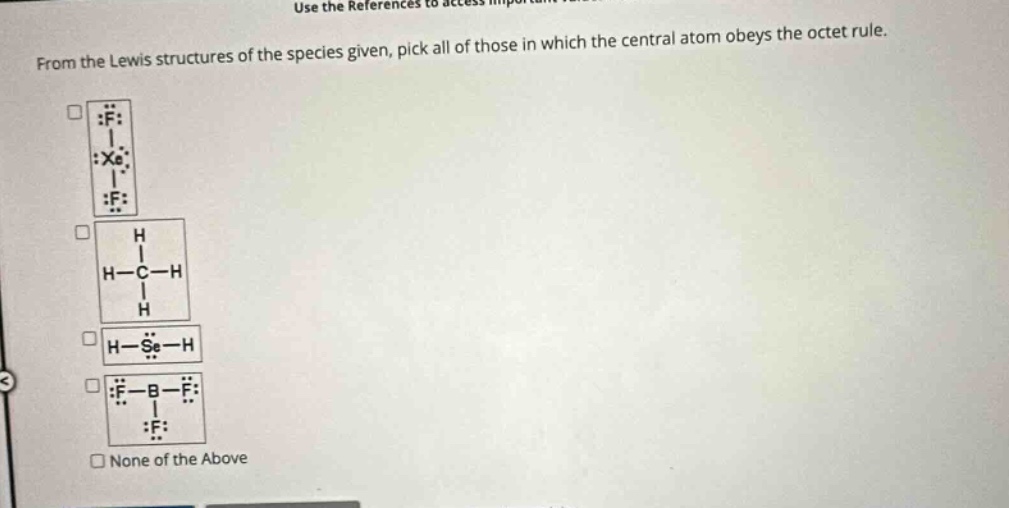
Step2: Analyze XeF₂
The central atom Xe has 2 single bonds and 3 lone pairs. Total electrons = $2 \times (\text{electrons per bond}) + 3 \times (\text{electrons per lone pair}) = 2 \times 2 + 3 \times 2 = 4 + 6 = 10$ electrons. Xe does not obey the octet rule.
Step3: Analyze CH₄
The central atom C has 4 single bonds and 0 lone pairs. Total electrons = $4 \times (\text{electrons per bond}) + 0 \times (\text{electrons per lone pair}) = 4 \times 2 + 0 = 8$ electrons. C obeys the octet rule.
Step4: Analyze H₂Se
The central atom Se has 2 single bonds and 2 lone pairs. Total electrons = $2 \times (\text{electrons per bond}) + 2 \times (\text{electrons per lone pair}) = 2 \times 2 + 2 \times 2 = 4 + 4 = 8$ electrons. Se obeys the octet rule.
Step5: Analyze BF₃
The central atom B has 3 single bonds and 0 lone pairs. Total electrons = $3 \times (\text{electrons per bond}) + 0 \times (\text{electrons per lone pair}) = 3 \times 2 + 0 = 6$ electrons. B does not obey the octet rule.
Answer:
The structures in which the central atom obeys the octet rule are:
- The second structure (CH₄)
- The third structure (H₂Se)