use the references to access important values if needed for this question. be sure to specify states such as…
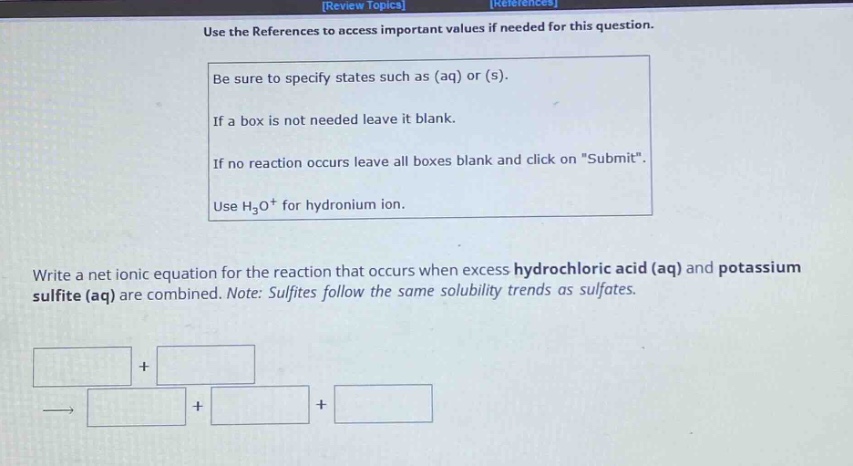
use the references to access important values if needed for this question. be sure to specify states such as (aq) or (s). if a box is not needed leave it blank. if no reaction occurs leave all boxes blank and click on \submit\. use h₃o⁺ for hydronium ion. write a net ionic equation for the reaction that occurs when excess hydrochloric acid (aq) and potassium sulfite (aq) are combined. note: sulfites follow the same solubility trends as sulfates.
Answer
Answer:
$2H^+(aq)+SO_3^{2 - }(aq)\rightarrow H_2O(l)+SO_2(g)$
Explanation:
Step1: Write molecular equation
$2HCl(aq)+K_2SO_3(aq)\rightarrow 2KCl(aq)+H_2O(l)+SO_2(g)$
Step2: Write complete ionic equation
$2H^+(aq)+2Cl^-(aq)+2K^+(aq)+SO_3^{2 - }(aq)\rightarrow 2K^+(aq)+2Cl^-(aq)+H_2O(l)+SO_2(g)$
Step3: Cancel spectator ions
Spectator ions ($K^+$ and $Cl^-$) are removed to get net - ionic equation.