use the table to answer the questions below. when the temperature in a room increases from 25°c to 33°c…
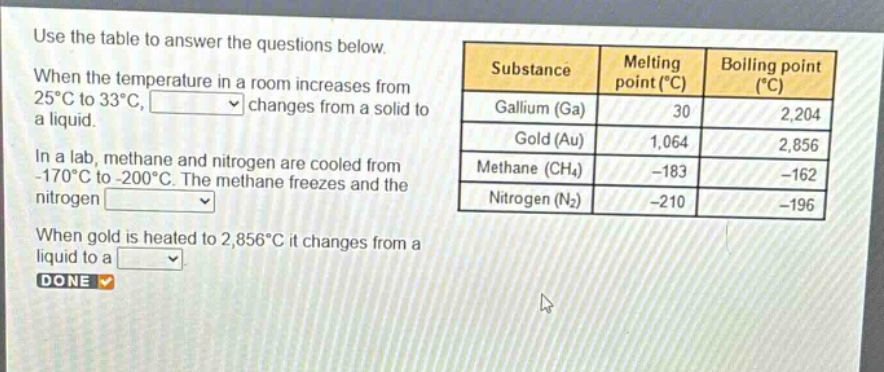
use the table to answer the questions below. when the temperature in a room increases from 25°c to 33°c, changes from a solid to a liquid. in a lab, methane and nitrogen are cooled from -170°c to -200°c. the methane freezes and the nitrogen. when gold is heated to 2,856°c it changes from a liquid to a. done
Answer
Answer:
- Gallium
- Remains a gas
- Gas
Explanation:
Step1: Analyze gallium's state change
The room - temperature range is from 25°C to 33°C. Gallium's melting point is 30°C. When the temperature increases from 25°C (below melting point, solid) to 33°C (above melting point, liquid), gallium changes from a solid to a liquid.
Step2: Analyze nitrogen's state change
Methane freezes at - 183°C and nitrogen's melting point is - 210°C and boiling point is - 196°C. When cooled from - 170°C to - 200°C, since - 200°C is above its melting point (-210°C) and below its boiling point (-196°C), nitrogen remains a gas.
Step3: Analyze gold's state change
Gold's boiling point is 2,856°C. When heated to 2,856°C, it changes from a liquid to a gas.