using the activity series provided. which reactants will form products?\nna > mg > al > mn > zn > cr > fe >…
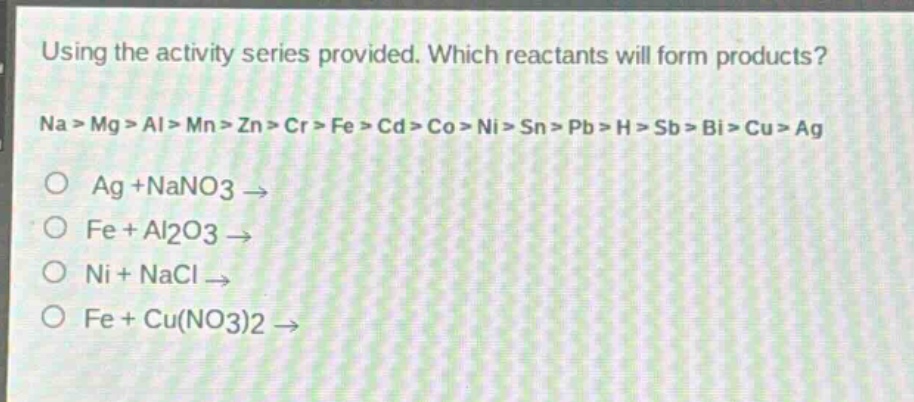
using the activity series provided. which reactants will form products?\nna > mg > al > mn > zn > cr > fe > cd > co > ni > sn > pb > h > sb > bi > cu > ag\no ag +nano3 →\no fe + al2o3 →\no ni + nacl →\no fe + cu(no3)2 →
Answer
Explanation:
Step1: Recall displacement - reaction rule
In a single - displacement reaction, a more reactive metal can displace a less reactive metal from its compound.
Step2: Analyze Ag + NaNO3
Ag is less reactive than Na according to the activity series ($Na>Ag$), so no reaction occurs.
Step3: Analyze Fe + Al2O3
Fe is less reactive than Al ($Al > Fe$), so no reaction occurs.
Step4: Analyze Ni + NaCl
Ni is less reactive than Na ($Na>Ni$), so no reaction occurs.
Step5: Analyze Fe + Cu(NO3)2
Fe is more reactive than Cu ($Fe > Cu$). Fe will displace Cu from $Cu(NO_3)_2$ to form $Fe(NO_3)_2$ and Cu. The reaction is $Fe + Cu(NO_3)_2\rightarrow Fe(NO_3)_2+Cu$.
Answer:
Fe + Cu(NO3)2 →