2. using the following unbalanced equation, ch₄ + o₂ → co₂ + h₂o, how many moles of o₂ would be required to…
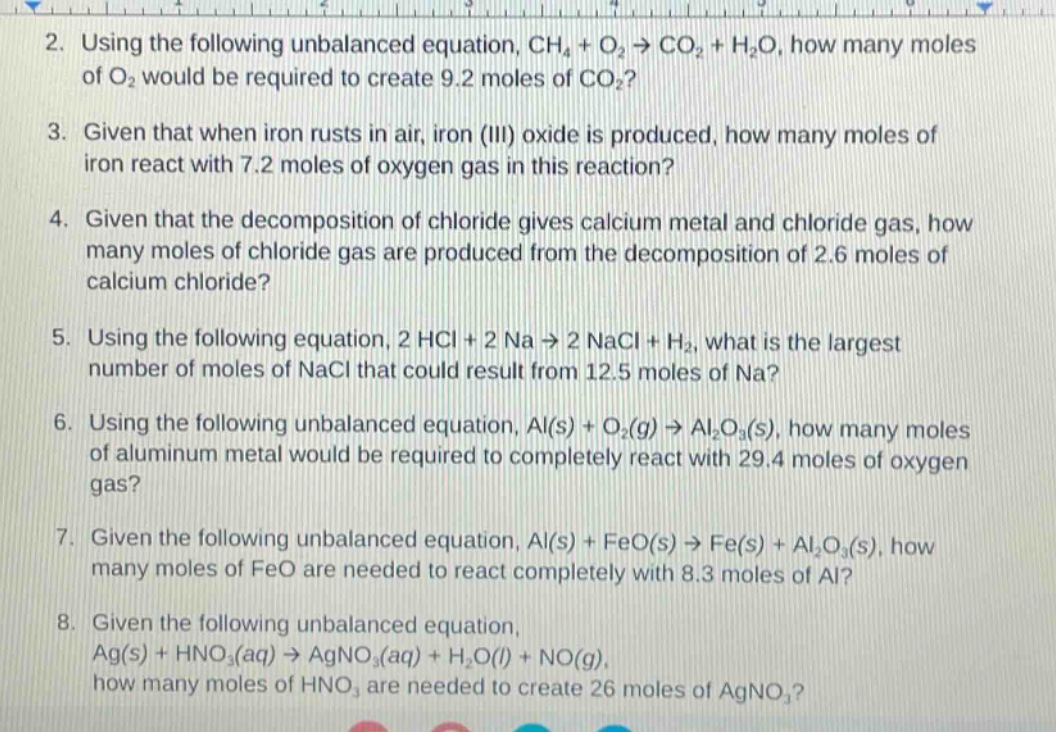
2. using the following unbalanced equation, ch₄ + o₂ → co₂ + h₂o, how many moles of o₂ would be required to create 9.2 moles of co₂?\n3. given that when iron rusts in air, iron (iii) oxide is produced, how many moles of iron react with 7.2 moles of oxygen gas in this reaction?\n4. given that the decomposition of chloride gives calcium metal and chloride gas, how many moles of chloride gas are produced from the decomposition of 2.6 moles of calcium chloride?\n5. using the following equation, 2 hcl + 2 na → 2 nacl + h₂, what is the largest number of moles of nacl that could result from 12.5 moles of na?\n6. using the following unbalanced equation, al(s) + o₂(g) → al₂o₃(s), how many moles of aluminum metal would be required to completely react with 29.4 moles of oxygen gas?\n7. given the following unbalanced equation, al(s) + feo(s) → fe(s) + al₂o₃(s), how many moles of feo are needed to react completely with 8.3 moles of al?\n8. given the following unbalanced equation, ag(s) + hno₃(aq) → agno₃(aq) + h₂o(l) + no(g), how many moles of hno₃ are needed to create 26 moles of agno₃?
Answer
Explanation:
Step1: Balance the equation
For $CH_4 + O_2\rightarrow CO_2 + H_2O$, the balanced equation is $CH_4+2O_2\rightarrow CO_2 + 2H_2O$. From the balanced - equation, the mole - ratio of $O_2$ to $CO_2$ is $2:1$.
Step2: Calculate moles of $O_2$
If $n(CO_2)=9.2$ moles, and $\frac{n(O_2)}{n(CO_2)}=\frac{2}{1}$, then $n(O_2)=2\times n(CO_2)$. So $n(O_2)=2\times9.2 = 18.4$ moles.
For the reaction of iron rusting: $4Fe + 3O_2\rightarrow 2Fe_2O_3$. The mole - ratio of $Fe$ to $O_2$ is $4:3$. If $n(O_2)=7.2$ moles, then $n(Fe)=\frac{4}{3}\times n(O_2)=\frac{4}{3}\times7.2 = 9.6$ moles.
For the decomposition of calcium chloride: $CaCl_2\rightarrow Ca+Cl_2$. The mole - ratio of $Cl_2$ to $CaCl_2$ is $1:1$. If $n(CaCl_2)=2.6$ moles, then $n(Cl_2)=2.6$ moles.
For the reaction $2HCl + 2Na\rightarrow 2NaCl+H_2$, the mole - ratio of $NaCl$ to $Na$ is $1:1$. If $n(Na)=12.5$ moles, then $n(NaCl)=12.5$ moles.
For the reaction $Al(s)+O_2(g)\rightarrow Al_2O_3(s)$, the balanced equation is $4Al + 3O_2\rightarrow 2Al_2O_3$. The mole - ratio of $Al$ to $O_2$ is $4:3$. If $n(O_2)=29.4$ moles, then $n(Al)=\frac{4}{3}\times n(O_2)=\frac{4}{3}\times29.4 = 39.2$ moles.
For the reaction $Al(s)+FeO(s)\rightarrow Fe(s)+Al_2O_3(s)$, the balanced equation is $2Al + 3FeO\rightarrow 3Fe+Al_2O_3$. The mole - ratio of $FeO$ to $Al$ is $3:2$. If $n(Al)=8.3$ moles, then $n(FeO)=\frac{3}{2}\times n(Al)=\frac{3}{2}\times8.3 = 12.45$ moles.
For the reaction $Ag(s)+HNO_3(aq)\rightarrow AgNO_3(aq)+H_2O(l)+NO(g)$, the balanced equation is $3Ag + 4HNO_3\rightarrow 3AgNO_3+2H_2O+NO$. The mole - ratio of $HNO_3$ to $AgNO_3$ is $4:3$. If $n(AgNO_3)=26$ moles, then $n(HNO_3)=\frac{4}{3}\times n(AgNO_3)=\frac{4}{3}\times26=\frac{104}{3}\approx34.67$ moles.
Answer:
- $18.4$ moles
- $9.6$ moles
- $2.6$ moles
- $12.5$ moles
- $39.2$ moles
- $12.45$ moles
- $\frac{104}{3}\approx34.67$ moles