there are a variety of cations that migrate across cell membranes as part of the nerve signal initiation in…
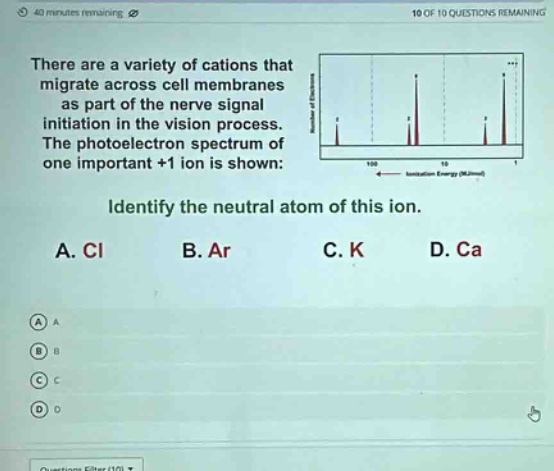
there are a variety of cations that migrate across cell membranes as part of the nerve signal initiation in the vision process. the photoelectron spectrum of one important +1 ion is shown: identify the neutral atom of this ion. a. cl b. ar c. k d. ca
Answer
Explanation:
Step1: Analyze ion charge
The ion has a +1 charge. This means the neutral atom has one more electron than the ion.
Step2: Recall electron - loss pattern
A +1 ion is formed by losing one electron. We need to find an atom that when it loses one electron, has an electron - configuration consistent with the properties described (though not explicitly shown in detail from the spectrum here, but based on charge).
Step3: Evaluate options
- Chlorine (Cl) has 17 electrons. A Cl⁺ ion has 16 electrons.
- Argon (Ar) is a noble gas with 18 electrons. It doesn't typically form a +1 ion easily.
- Potassium (K) has 19 electrons. When it loses one electron to form K⁺, it has a stable electron - configuration similar to a noble gas (Ar).
- Calcium (Ca) has 20 electrons and typically forms a +2 ion (Ca²⁺) by losing two electrons to achieve a noble - gas electron - configuration.
Answer:
C. K