water forms according to the equation below: 2h₂(g) + o₂(g) → 2h₂o(g) δhᵣₓₙ = -483.64 kj how much energy is…
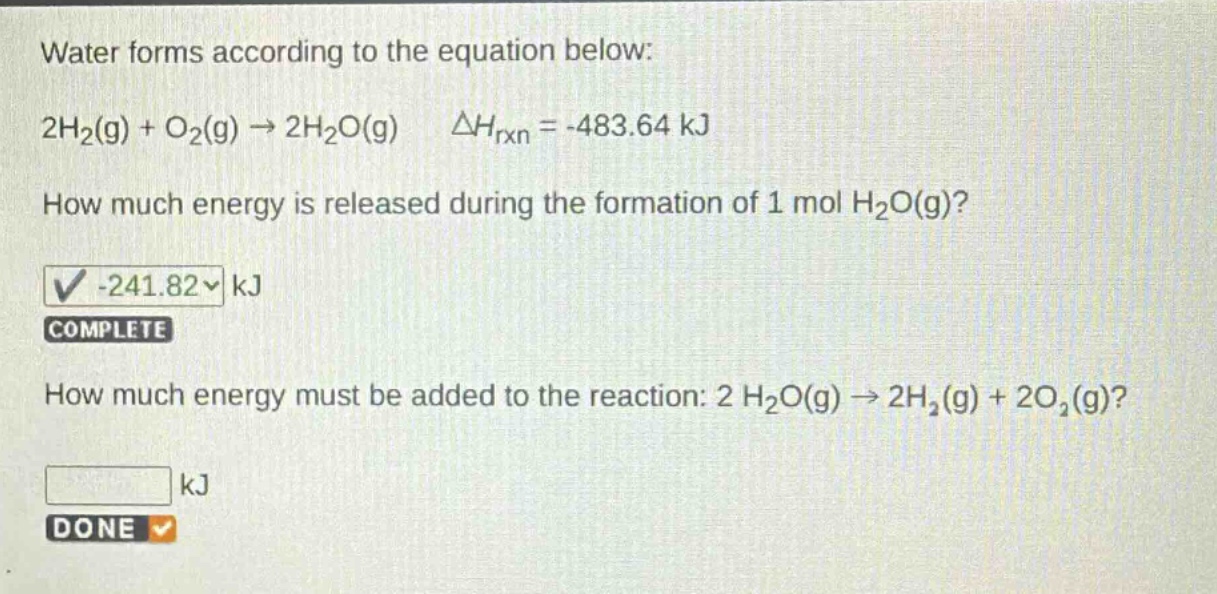
water forms according to the equation below: 2h₂(g) + o₂(g) → 2h₂o(g) δhᵣₓₙ = -483.64 kj how much energy is released during the formation of 1 mol h₂o(g)? -241.82 kj complete how much energy must be added to the reaction: 2 h₂o(g) → 2h₂(g) + 2o₂(g)? kj done
Answer
Explanation:
Step1: Analyze the given reaction
The reaction $2H_2(g)+O_2(g)\rightarrow2H_2O(g)$ has $\Delta H_{rxn}=- 483.64\ kJ$. This is the energy change for the formation of 2 moles of $H_2O(g)$.
Step2: Calculate energy for 1 - mol $H_2O(g)$ formation
For the formation of 1 - mol $H_2O(g)$, we divide the $\Delta H_{rxn}$ by 2. Since $\Delta H_{rxn}=-483.64\ kJ$ for 2 moles of $H_2O(g)$, for 1 - mol $H_2O(g)$ the energy change $\Delta H=\frac{-483.64}{2}=-241.82\ kJ$.
Step3: Analyze the reverse reaction
The reverse reaction of $2H_2(g)+O_2(g)\rightarrow2H_2O(g)$ is $2H_2O(g)\rightarrow2H_2(g)+O_2(g)$. The $\Delta H$ value for a reverse reaction has the same magnitude but opposite sign. Since the forward - reaction $\Delta H=-483.64\ kJ$, for the reaction $2H_2O(g)\rightarrow2H_2(g)+O_2(g)$, $\Delta H = 483.64\ kJ$.
Answer:
483.64