waters molar mass is 18.01 g/mol. the molar mass of glycerol is 92.09 g/mol. at 25°c, glycerol is more…
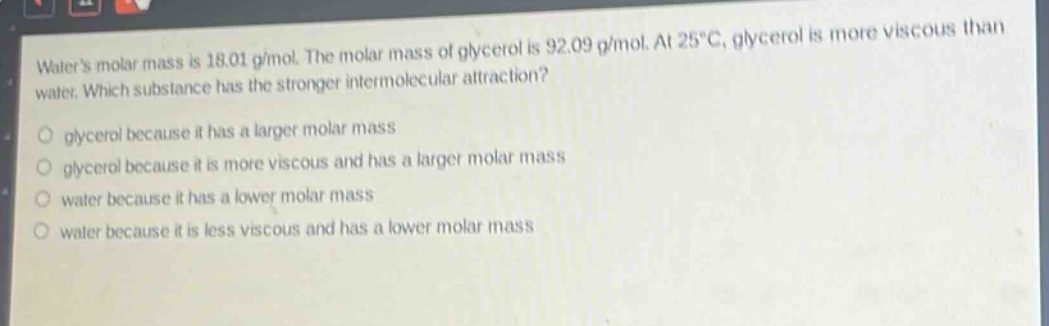
waters molar mass is 18.01 g/mol. the molar mass of glycerol is 92.09 g/mol. at 25°c, glycerol is more viscous than water. which substance has the stronger intermolecular attraction?\n glycerol because it has a larger molar mass\n glycerol because it is more viscous and has a larger molar mass\n water because it has a lower molar mass\n water because it is less viscous and has a lower molar mass
Answer
Answer:
glycerol because it is more viscous and has a larger molar mass
Explanation:
Step1: Understand viscosity - intermolecular force relation
Viscosity is related to intermolecular forces. Stronger forces mean higher viscosity.
Step2: Analyze molar - mass and intermolecular forces
Larger molar mass often implies more complex molecules with stronger intermolecular forces.
Step3: Compare glycerol and water
Glycerol is more viscous and has a larger molar mass than water, indicating stronger intermolecular attraction.