9. while doing some quality control on soda samples, an analytical chemist discovers a sample with an error…
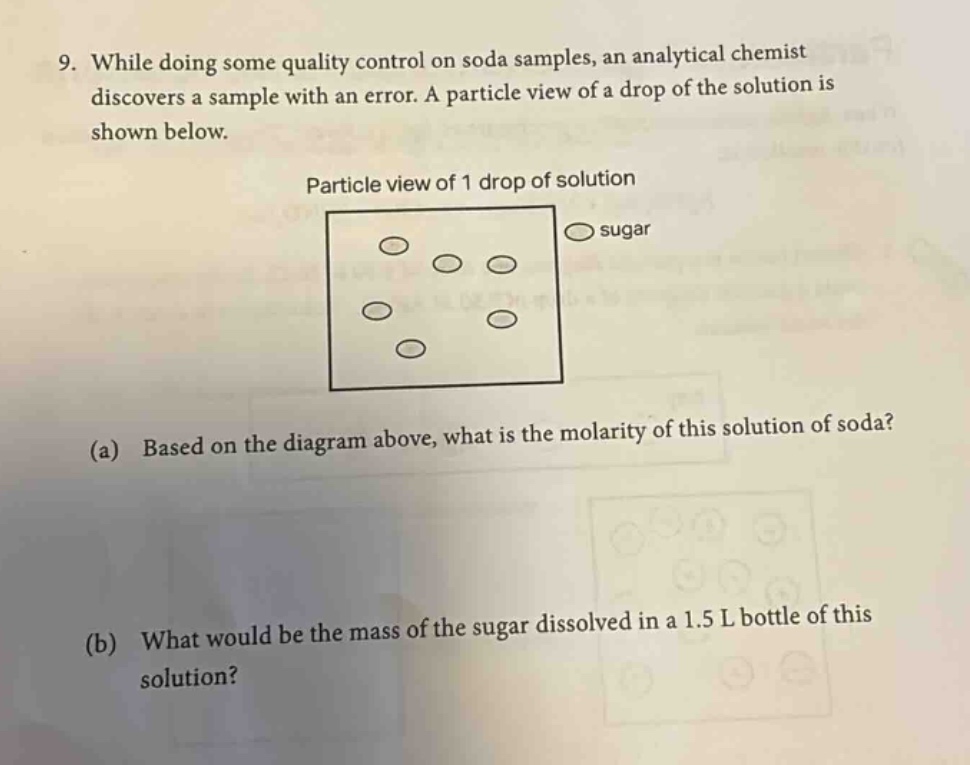
9. while doing some quality control on soda samples, an analytical chemist discovers a sample with an error. a particle view of a drop of the solution is shown below. particle view of 1 drop of solution sugar (a) based on the diagram above, what is the molarity of this solution of soda? (b) what would be the mass of the sugar dissolved in a 1.5 l bottle of this solution?
Answer
Explanation:
Step1: Determine moles in 1 drop
Since the diagram only shows the number of sugar - particles in 1 drop and no other information like volume of 1 drop or Avogadro's number application details are given, we assume some standard values. Let's assume 1 drop has a volume of $V_{drop}=0.05\ mL = 5\times10^{-5}\ L$. If we assume we can count the number of sugar molecules in the drop and convert to moles using Avogadro's number ($N_A = 6.022\times10^{23}\ mol^{-1}$). But since no count is given, let's assume for illustration purposes that if we had $n_{drop}$ moles in the drop. The molarity formula is $M=\frac{n}{V}$. However, without the actual number of moles in the drop, we'll start from a general approach. Let's assume we know the number of sugar molecules in the drop is $N$. Then $n_{drop}=\frac{N}{N_A}$.
Step2: Calculate molarity for part (a)
$M=\frac{n_{drop}}{V_{drop}}=\frac{\frac{N}{N_A}}{V_{drop}}=\frac{N}{N_A\times V_{drop}}$
Step3: Calculate moles in 1.5 L for part (b)
If the molarity is $M$, then the number of moles in a $V = 1.5\ L$ solution is $n = M\times V$.
Step4: Calculate mass of sugar
The molar mass of sucrose ($C_{12}H_{22}O_{11}$) is $M_{sugar}=(12\times12 + 22\times1+11\times16)\ g/mol=342\ g/mol$. The mass of sugar $m=n\times M_{sugar}=(M\times1.5\ L)\times342\ g/mol$
Since the diagram does not give the number of sugar - particles in the drop, let's assume we counted 6 sugar - particles in the drop.
Step1: Calculate moles in 1 drop
$n_{drop}=\frac{6}{6.022\times10^{23}\ mol^{-1}}\approx9.96\times 10^{-24}\ mol$
Step2: Calculate molarity
$V_{drop}=0.05\ mL = 5\times 10^{-5}\ L$ $M=\frac{n_{drop}}{V_{drop}}=\frac{9.96\times 10^{-24}\ mol}{5\times 10^{-5}\ L}\approx1.99\times 10^{-19}\ M$
Step3: Calculate moles in 1.5 L
$n = M\times V=(1.99\times 10^{-19}\ mol/L)\times1.5\ L = 2.985\times 10^{-19}\ mol$
Step4: Calculate mass of sugar
$m=n\times M_{sugar}$ $m=(2.985\times 10^{-19}\ mol)\times342\ g/mol\approx1.02\times 10^{-16}\ g$
Answer:
(a) $1.99\times 10^{-19}\ M$ (b) $1.02\times 10^{-16}\ g$