worksheet: chemical bonding - ionic & covalent! remember... ionic bond between a metal and non - metal (m +…
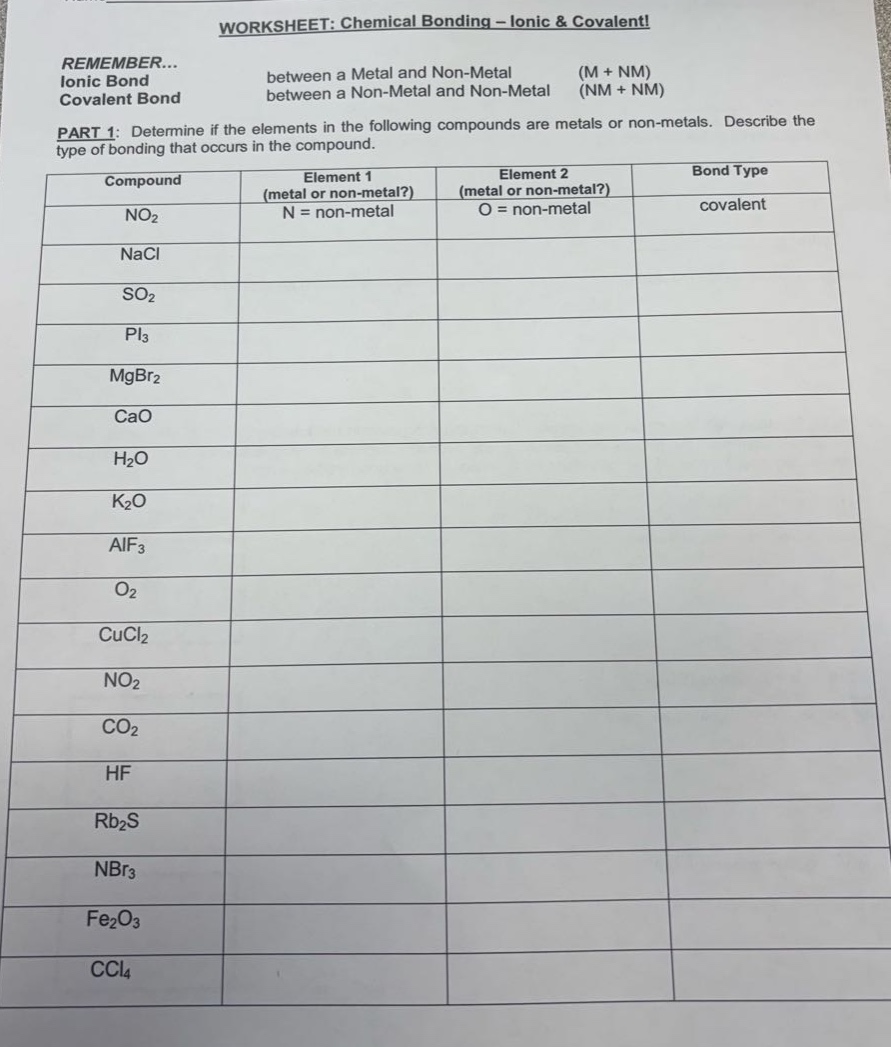
worksheet: chemical bonding - ionic & covalent! remember... ionic bond between a metal and non - metal (m + nm) covalent bond between a non - metal and non - metal (nm + nm) part 1: determine if the elements in the following compounds are metals or non - metals. describe the type of bonding that occurs in the compound. compound element 1 (metal or non - metal?) element 2 (metal or non - metal?) bond type no2 n = non - metal o = non - metal covalent nacl so2 pi3 mgbr2 cao h2o k2o alf3 o2 cucl2 no2 co2 hf rb2s nbr3 fe2o3 ccl4
Answer
Explanation:
Step1: Recall metal - non - metal classification
Metals are typically found on the left and middle of the periodic table, non - metals on the right.
Step2: Analyze each compound
For $NaCl$:
- Sodium (Na) is a metal, chlorine (Cl) is a non - metal. Bond type is ionic. For $SO_2$:
- Sulfur (S) is a non - metal, oxygen (O) is a non - metal. Bond type is covalent. For $PI_3$:
- Phosphorus (P) is a non - metal, iodine (I) is a non - metal. Bond type is covalent. For $MgBr_2$:
- Magnesium (Mg) is a metal, bromine (Br) is a non - metal. Bond type is ionic. For $CaO$:
- Calcium (Ca) is a metal, oxygen (O) is a non - metal. Bond type is ionic. For $H_2O$:
- Hydrogen (H) is a non - metal, oxygen (O) is a non - metal. Bond type is covalent. For $K_2O$:
- Potassium (K) is a metal, oxygen (O) is a non - metal. Bond type is ionic. For $AlF_3$:
- Aluminum (Al) is a metal, fluorine (F) is a non - metal. Bond type is ionic. For $O_2$:
- Oxygen (O) is a non - metal, it's a non - metal - non - metal bond (diatomic molecule), bond type is covalent. For $CuCl_2$:
- Copper (Cu) is a metal, chlorine (Cl) is a non - metal. Bond type is ionic. For $NO_2$ (already given example but for completeness):
- Nitrogen (N) is a non - metal, oxygen (O) is a non - metal. Bond type is covalent. For $CO_2$:
- Carbon (C) is a non - metal, oxygen (O) is a non - metal. Bond type is covalent. For $HF$:
- Hydrogen (H) is a non - metal, fluorine (F) is a non - metal. Bond type is covalent. For $Rb_2S$:
- Rubidium (Rb) is a metal, sulfur (S) is a non - metal. Bond type is ionic. For $NBr_3$:
- Nitrogen (N) is a non - metal, bromine (Br) is a non - metal. Bond type is covalent. For $Fe_2O_3$:
- Iron (Fe) is a metal, oxygen (O) is a non - metal. Bond type is ionic. For $CCl_4$:
- Carbon (C) is a non - metal, chlorine (Cl) is a non - metal. Bond type is covalent.
Answer:
| Compound | Element 1 (metal or non - metal?) | Element 2 (metal or non - metal?) | Bond Type |
|---|---|---|---|
| $NO_2$ | $N$ = non - metal | $O$ = non - metal | covalent |
| $NaCl$ | $Na$ = metal | $Cl$ = non - metal | ionic |
| $SO_2$ | $S$ = non - metal | $O$ = non - metal | covalent |
| $PI_3$ | $P$ = non - metal | $I$ = non - metal | covalent |
| $MgBr_2$ | $Mg$ = metal | $Br$ = non - metal | ionic |
| $CaO$ | $Ca$ = metal | $O$ = non - metal | ionic |
| $H_2O$ | $H$ = non - metal | $O$ = non - metal | covalent |
| $K_2O$ | $K$ = metal | $O$ = non - metal | ionic |
| $AlF_3$ | $Al$ = metal | $F$ = non - metal | ionic |
| $O_2$ | $O$ = non - metal | $O$ = non - metal | covalent |
| $CuCl_2$ | $Cu$ = metal | $Cl$ = non - metal | ionic |
| $NO_2$ | $N$ = non - metal | $O$ = non - metal | covalent |
| $CO_2$ | $C$ = non - metal | $O$ = non - metal | covalent |
| $HF$ | $H$ = non - metal | $F$ = non - metal | covalent |
| $Rb_2S$ | $Rb$ = metal | $S$ = non - metal | ionic |
| $NBr_3$ | $N$ = non - metal | $Br$ = non - metal | covalent |
| $Fe_2O_3$ | $Fe$ = metal | $O$ = non - metal | ionic |
| $CCl_4$ | $C$ = non - metal | $Cl$ = non - metal | covalent |