write the formula for the following compounds: 1. calcium bromide 2. hydrogen sulfide 3. potassium phosphide…
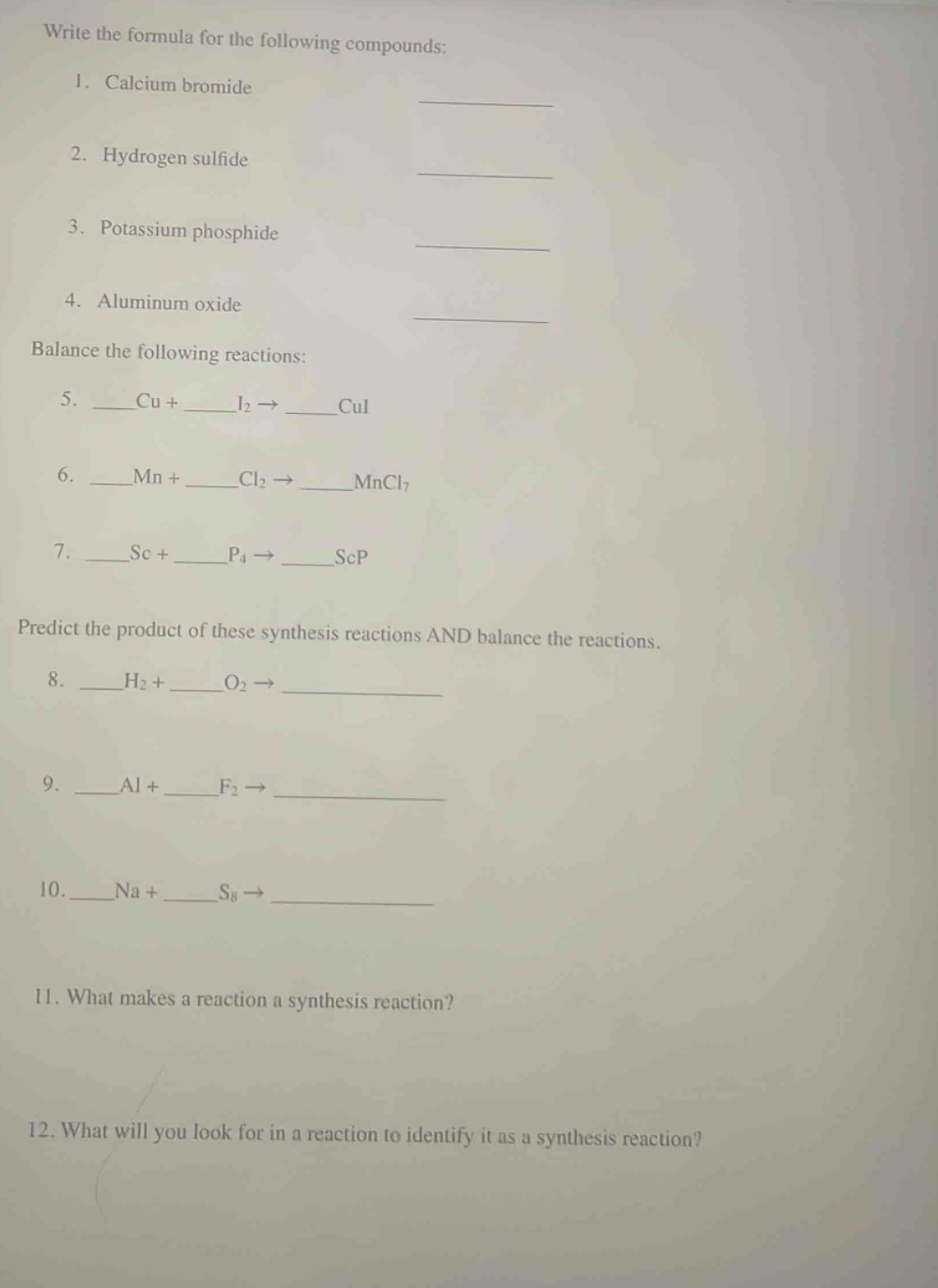
write the formula for the following compounds: 1. calcium bromide 2. hydrogen sulfide 3. potassium phosphide 4. aluminum oxide balance the following reactions: 5. __cu + __i2 → __cui 6. __mn + __cl2 → __mncl7 7. __sc + __p4 → __scp predict the product of these synthesis reactions and balance the reactions. 8. __h2 + __o2 → ____ 9. __al + __f2 → ____ 10. __na + __s8 → ____ 11. what makes a reaction a synthesis reaction? 12. what will you look for in a reaction to identify it as a synthesis reaction?
Answer
Explanation:
Step1: Determine formulas of compounds
- Calcium has a +2 charge ($Ca^{2 + }$) and bromide has a -1 charge ($Br^{-}$). To balance the charges, the formula is $CaBr_{2}$.
- Hydrogen has a +1 charge ($H^{+}$) and sulfide has a -2 charge ($S^{2 - }$). The formula is $H_{2}S$.
- Potassium has a +1 charge ($K^{+}$) and phosphide has a -3 charge ($P^{3 - }$). The formula is $K_{3}P$.
- Aluminum has a +3 charge ($Al^{3+}$) and oxide has a -2 charge ($O^{2 - }$). The formula is $Al_{2}O_{3}$.
Step2: Balance chemical - reactions
- For $Cu+I_{2}\to CuI$, there are 2 iodine atoms on the left - hand side. So, we need 2 moles of $CuI$ on the right - hand side. Then we need 2 moles of $Cu$ on the left - hand side. The balanced equation is $2Cu + I_{2}\to2CuI$.
- For $Mn+Cl_{2}\to MnCl_{7}$, there are 2 chlorine atoms on the left - hand side and 7 on the right - hand side. The least common multiple of 2 and 7 is 14. So, we need 7 moles of $Cl_{2}$ and 2 moles of $MnCl_{7}$. Then we need 2 moles of $Mn$. The balanced equation is $2Mn+7Cl_{2}\to2MnCl_{7}$.
- For $Sc + P_{4}\to ScP$, there are 4 phosphorus atoms on the left - hand side. So, we need 4 moles of $ScP$ on the right - hand side. Then we need 4 moles of $Sc$ on the left - hand side. The balanced equation is $4Sc+P_{4}\to4ScP$.
- For $H_{2}+O_{2}\to$, the product is water ($H_{2}O$). There are 2 oxygen atoms on the left - hand side, so we need 2 moles of $H_{2}O$. Then we need 2 moles of $H_{2}$. The balanced equation is $2H_{2}+O_{2}\to2H_{2}O$.
- For $Al + F_{2}\to$, the product is $AlF_{3}$. There are 2 fluorine atoms on the left - hand side and 3 on the right - hand side. The least common multiple of 2 and 3 is 6. So, we need 3 moles of $F_{2}$ and 2 moles of $AlF_{3}$. Then we need 2 moles of $Al$. The balanced equation is $2Al + 3F_{2}\to2AlF_{3}$.
- For $Na+S_{8}\to$, the product is $Na_{2}S$. There are 8 sulfur atoms on the left - hand side, so we need 8 moles of $Na_{2}S$. Then we need 16 moles of $Na$. The balanced equation is $16Na+S_{8}\to8Na_{2}S$.
Step3: Define synthesis reaction
- A synthesis reaction is a reaction in which two or more substances combine to form a single product.
- To identify a synthesis reaction, look for a reaction where multiple reactants combine to give one product.
Answer:
- $CaBr_{2}$
- $H_{2}S$
- $K_{3}P$
- $Al_{2}O_{3}$
- $2Cu + I_{2}\to2CuI$
- $2Mn+7Cl_{2}\to2MnCl_{7}$
- $4Sc+P_{4}\to4ScP$
- $2H_{2}+O_{2}\to2H_{2}O$
- $2Al + 3F_{2}\to2AlF_{3}$
- $16Na+S_{8}\to8Na_{2}S$
- A reaction where two or more substances combine to form a single product.
- Multiple reactants combining to give one product.