if you have 100 grams of $n_2$ and excess $o_2$, how many liters of no can be produced? $n_2 + o_2 -> 2no$…
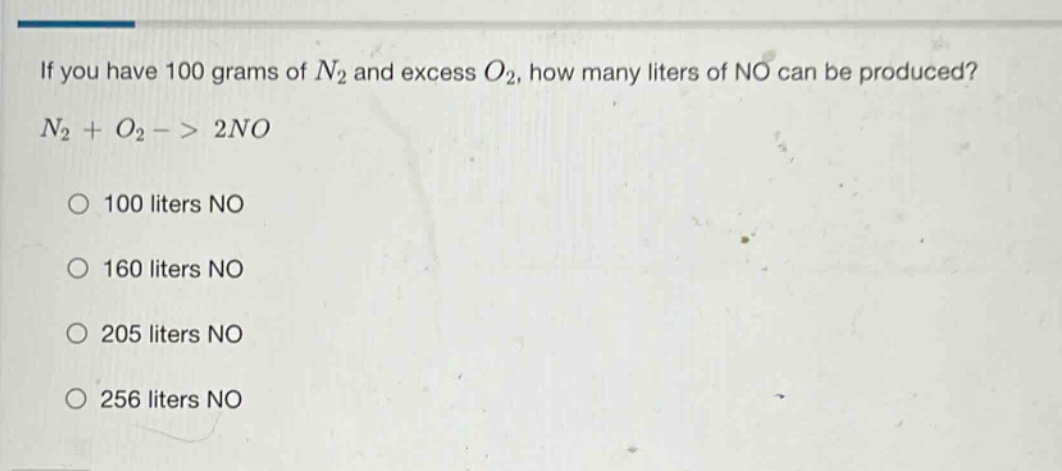
if you have 100 grams of $n_2$ and excess $o_2$, how many liters of no can be produced? $n_2 + o_2 -> 2no$ 100 liters no 160 liters no 205 liters no 256 liters no
Answer
Explanation:
Step1: Calculate moles of N₂
The molar mass of N₂ is $M_{N_2}=2\times14 = 28$ g/mol. Given mass of N₂, $m = 100$ g. Using the formula $n=\frac{m}{M}$, the number of moles of N₂, $n_{N_2}=\frac{100}{28}\approx3.57$ mol.
Step2: Determine moles of NO from stoichiometry
From the balanced chemical equation $N_2 + O_2\rightarrow2NO$, the mole - ratio of $N_2$ to $NO$ is 1:2. So, the number of moles of NO produced, $n_{NO}=2\times n_{N_2}=2\times3.57 = 7.14$ mol.
Step3: Calculate volume of NO at standard conditions
At standard temperature and pressure (STP), 1 mole of any gas occupies 22.4 L. Using the formula $V = n\times V_m$ (where $V_m = 22.4$ L/mol), the volume of NO, $V_{NO}=7.14\times22.4\approx160$ L.
Answer:
160 liters NO