you are given the reaction cu + hno₃ → cu(no₃)₂ + no + h₂o. which element is oxidized? which element is…
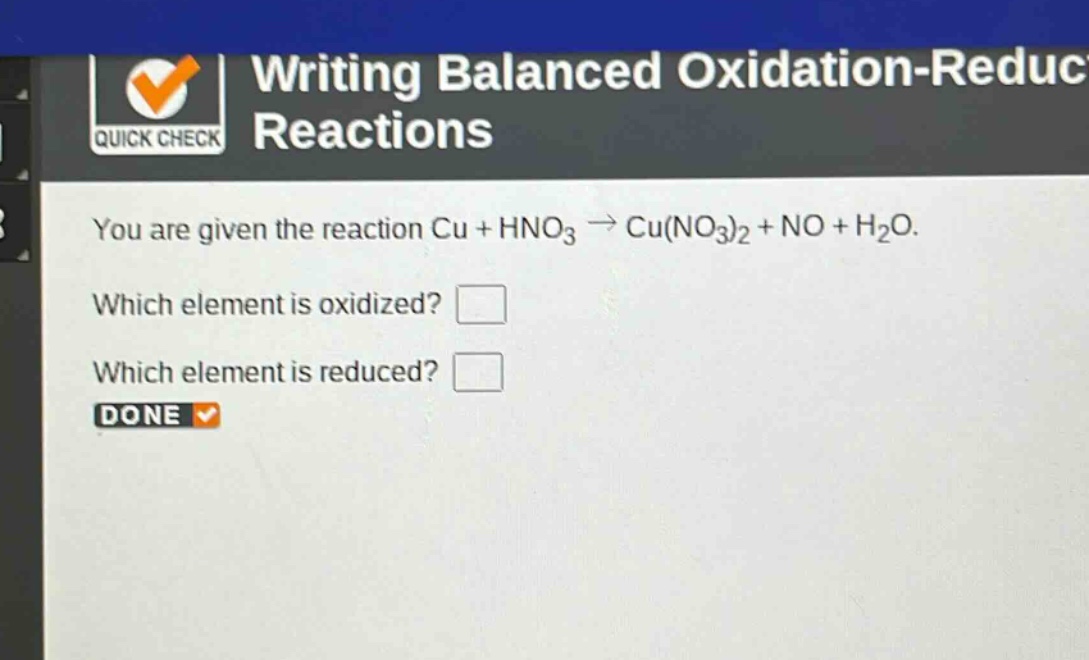
you are given the reaction cu + hno₃ → cu(no₃)₂ + no + h₂o. which element is oxidized? which element is reduced?
Answer
Explanation:
Step1: Determine oxidation - states of elements in reactants
In $Cu$, oxidation - state of $Cu$ is $0$. In $HNO_3$, $H$ has an oxidation - state of $+ 1$, $O$ has an oxidation - state of $-2$. Let the oxidation - state of $N$ be $x$. Then, $+1+x + 3\times(-2)=0$, so $x = +5$.
Step2: Determine oxidation - states of elements in products
In $Cu(NO_3)_2$, $O$ has an oxidation - state of $-2$, $N$ has an oxidation - state of $+5$. Let the oxidation - state of $Cu$ be $y$. Then, $y+2\times(+5)+2\times3\times(-2)=0$, so $y = +2$. In $NO$, $O$ has an oxidation - state of $-2$, let the oxidation - state of $N$ be $z$. Then, $z+(-2)=0$, so $z = +2$. In $H_2O$, $H$ has an oxidation - state of $+1$ and $O$ has an oxidation - state of $-2$.
Step3: Identify oxidized and reduced elements
Oxidation is the increase in oxidation - state. The oxidation - state of $Cu$ changes from $0$ to $+2$, so $Cu$ is oxidized. Reduction is the decrease in oxidation - state. The oxidation - state of $N$ changes from $+5$ in $HNO_3$ to $+2$ in $NO$, so $N$ is reduced.
Answer:
Which element is oxidized? $Cu$ Which element is reduced? $N$