you are learning how to classify matter using physical properties. your teacher hands you a silver - gray…
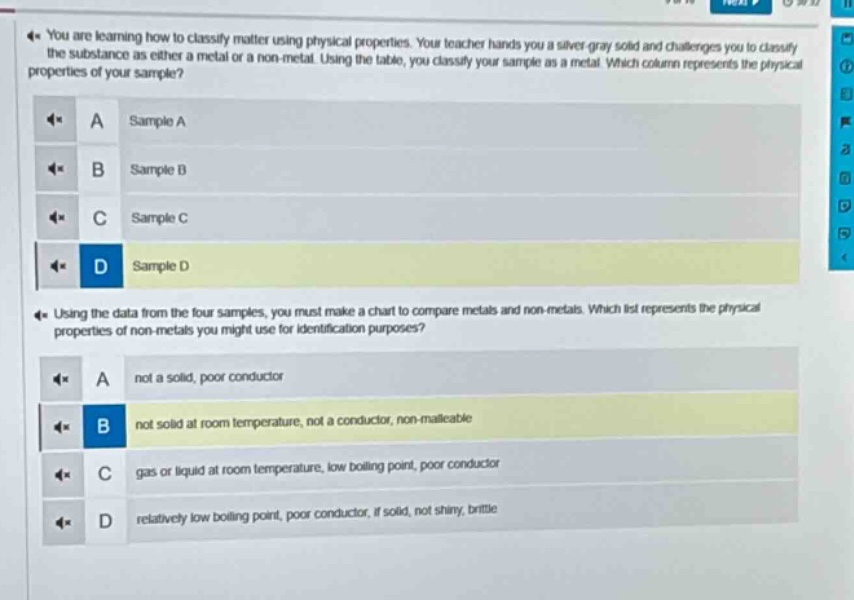
you are learning how to classify matter using physical properties. your teacher hands you a silver - gray solid and challenges you to classify the substance as either a metal or a non - metal. using the table, you classify your sample as a metal. which column represents the physical properties of your sample? a sample a b sample b c sample c d sample d using the data from the four samples, you must make a chart to compare metals and non - metals. which list represents the physical properties of non - metals you might use for identification purposes? a not a solid, poor conductor b not solid at room temperature, not a conductor, non - malleable c gas or liquid at room temperature, low boiling point, poor conductor d relatively low boiling point, poor conductor, if solid, not shiny, brittle
Answer
Brief Explanations:
Metals are typically solids at room - temperature, good conductors, and malleable. Non - metals have properties opposite to metals in many cases. For the first question, since the sample is classified as a metal, we need to look for properties typical of metals. For the second question, we identify the list with properties typical of non - metals. Non - metals can be solids, liquids or gases at room temperature, are poor conductors, and if solid, are often not shiny and brittle.
Answer:
For the first question, without seeing the content of columns A - D, we can't determine the answer. For the second question: D. relatively low boiling point, poor conductor, if solid, not shiny, brittle