2. if you had samples of hbr(aq) and br₂(l) in real life and you mixed them together, would you expect them…
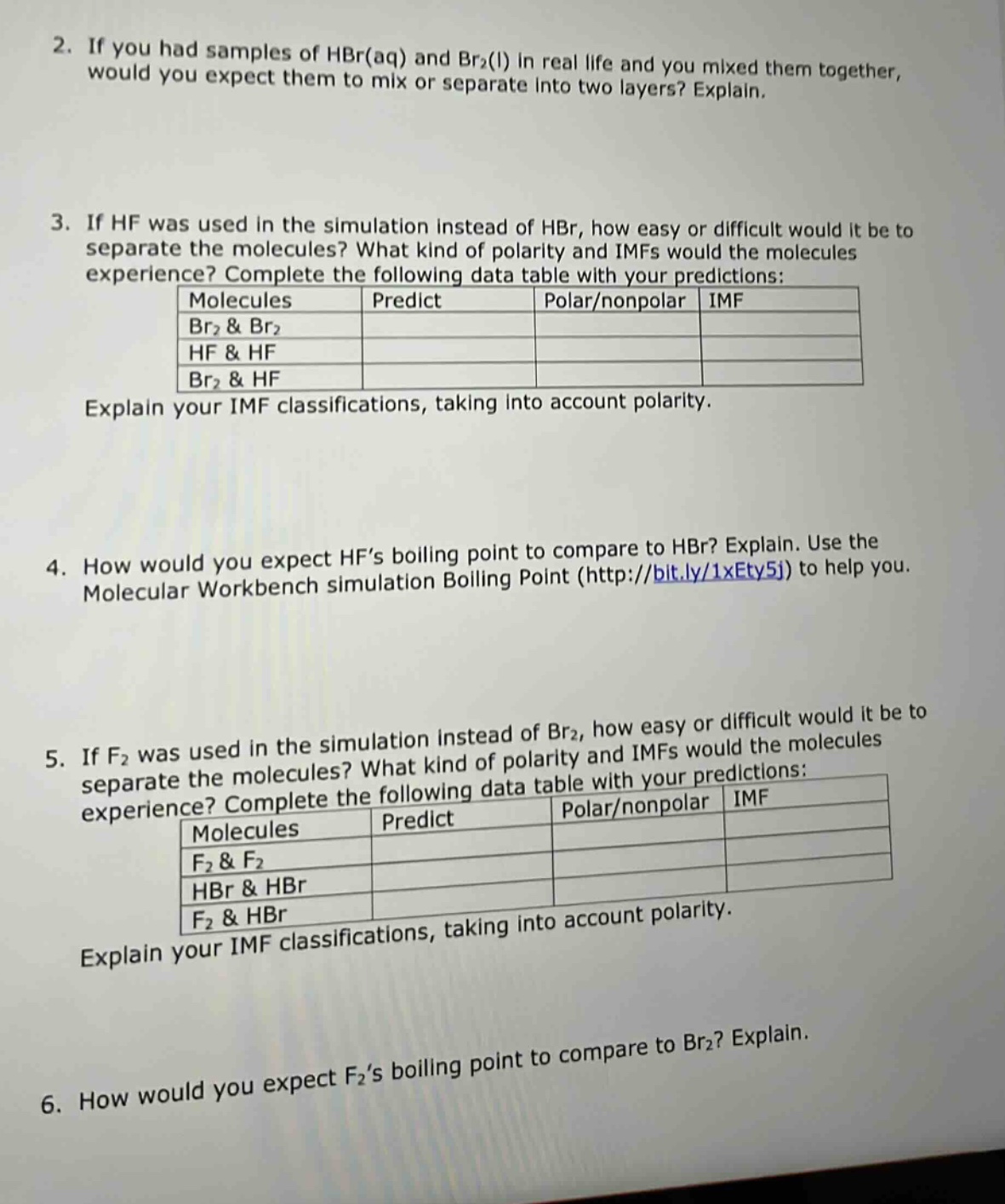
2. if you had samples of hbr(aq) and br₂(l) in real life and you mixed them together, would you expect them to mix or separate into two layers? explain.\n3. if hf was used in the simulation instead of hbr, how easy or difficult would it be to separate the molecules? what kind of polarity and imfs would the molecules experience? complete the following data table with your predictions:\nmolecules predict polar/nonpolar imf\nbr₂ & br₂\nhf & hf\nbr₂ & hf\nexplain your imf classifications, taking into account polarity.\n4. how would you expect hfs boiling point to compare to hbr? explain. use the molecular workbench simulation boiling point (http://bit.ly/1xety5j) to help you.\n5. if f₂ was used in the simulation instead of br₂, how easy or difficult would it be to separate the molecules? what kind of polarity and imfs would the molecules experience? complete the following data table with your predictions:\nmolecules predict polar/nonpolar imf\nf₂ & f₂\nhbr & hbr\nf₂ & hbr\nexplain your imf classifications, taking into account polarity.\n6. how would you expect f₂s boiling point to compare to br₂? explain.
Answer
Explanation:
Step1: Analyze mixing of HBr(aq) and Br₂(l)
HBr is polar and dissolves in water, while Br₂ is non - polar. They will separate into two layers as polar and non - polar substances do not mix well.
Step2: Analyze HF properties
HF is a polar molecule due to the large electronegativity difference between H and F. It has hydrogen bonding as its main intermolecular force (IMF).
| Molecules | Predict | Polar/nonpolar | IMF |
|---|---|---|---|
| Br₂ & Br₂ | Easy to separate | Non - polar | London dispersion forces |
| HF & HF | Difficult to separate | Polar | Hydrogen bonding |
| Br₂ & HF | Easy to separate | One non - polar, one polar | Dipole - induced dipole forces |
| Explanation for IMF classifications: Br₂ is non - polar so has only London dispersion forces. HF is polar and has hydrogen bonding. The mixture of Br₂ and HF has dipole - induced dipole forces due to the polar HF and non - polar Br₂. |
Step3: Compare boiling points of HF and HBr
HF has a higher boiling point than HBr. HF has hydrogen bonding, a stronger IMF compared to the dipole - dipole forces in HBr.
Step4: Analyze F₂ properties
F₂ is a non - polar molecule. It has only London dispersion forces as its IMF.
| Molecules | Predict | Polar/nonpolar | IMF |
|---|---|---|---|
| F₂ & F₂ | Easy to separate | Non - polar | London dispersion forces |
| HBr & HBr | Difficult to separate compared to F₂ & F₂ | Polar | Dipole - dipole forces |
| F₂ & HBr | Easy to separate | One non - polar, one polar | Dipole - induced dipole forces |
| Explanation for IMF classifications: F₂ is non - polar with London dispersion forces. HBr is polar with dipole - dipole forces. The mixture has dipole - induced dipole forces. |
Step5: Compare boiling points of F₂ and Br₂
Br₂ has a higher boiling point than F₂. Br₂ has more electrons than F₂, leading to stronger London dispersion forces.
Answer:
- They will separate into two layers because HBr is polar (aqueous) and Br₂ is non - polar.
- See the filled table above and explanation.
- HF has a higher boiling point than HBr due to hydrogen bonding in HF.
- See the filled table above and explanation.
- Br₂ has a higher boiling point than F₂ due to stronger London dispersion forces in Br₂.