13 a theater owner wants to sell tickets at a price that is between $5 and $20 each. at $5 per ticket, she…
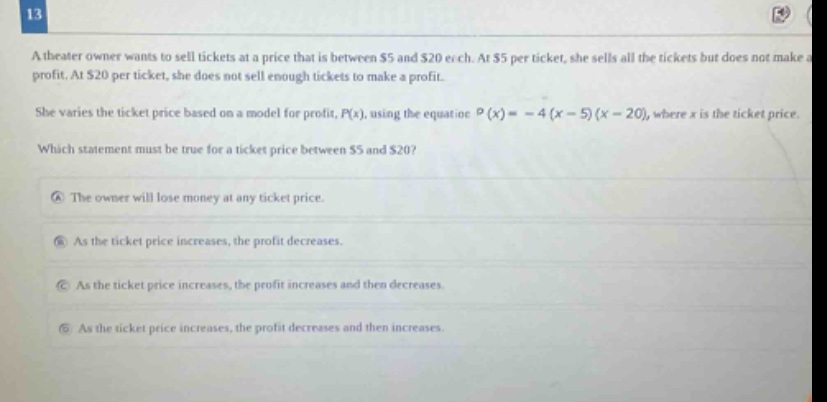
13 a theater owner wants to sell tickets at a price that is between $5 and $20 each. at $5 per ticket, she sells all the tickets but does not make a profit. at $20 per ticket, she does not sell enough tickets to make a profit. she varies the ticket price based on a model for profit, p(x), using the equation p(x)= - 4(x - 5)(x - 20), where x is the ticket price. which statement must be true for a ticket price between $5 and $20? a the owner will lose money at any ticket price. b as the ticket price increases, the profit decreases. c as the ticket price increases, the profit increases and then decreases. d as the ticket price increases, the profit decreases and then increases.
Answer
Explanation:
Step1: Expand the profit - function
First, expand $P(x)=-4(x - 5)(x - 20)$. Using the FOIL method, $(x - 5)(x - 20)=x^{2}-20x-5x + 100=x^{2}-25x + 100$. Then $P(x)=-4(x^{2}-25x + 100)=-4x^{2}+100x - 400$.
Step2: Identify the type of the function
The profit function $P(x)=-4x^{2}+100x - 400$ is a quadratic function in the form $y = ax^{2}+bx + c$, where $a=-4$, $b = 100$, and $c=-400$. Since $a=-4<0$, the graph of the function is a parabola that opens downwards.
Step3: Analyze the behavior of the function
For a quadratic function $y = ax^{2}+bx + c$ with $a<0$, the function has a maximum value. As $x$ (the ticket - price) increases from the lower - bound of the interval ($x = 5$) to the vertex of the parabola, the profit $P(x)$ increases. Then, as $x$ continues to increase from the vertex to the upper - bound of the interval ($x = 20$), the profit $P(x)$ decreases.
Answer:
C. As the ticket price increases, the profit increases and then decreases.