44 the table shows the net revenue in millions of dollars of a company every three months for two years. an…
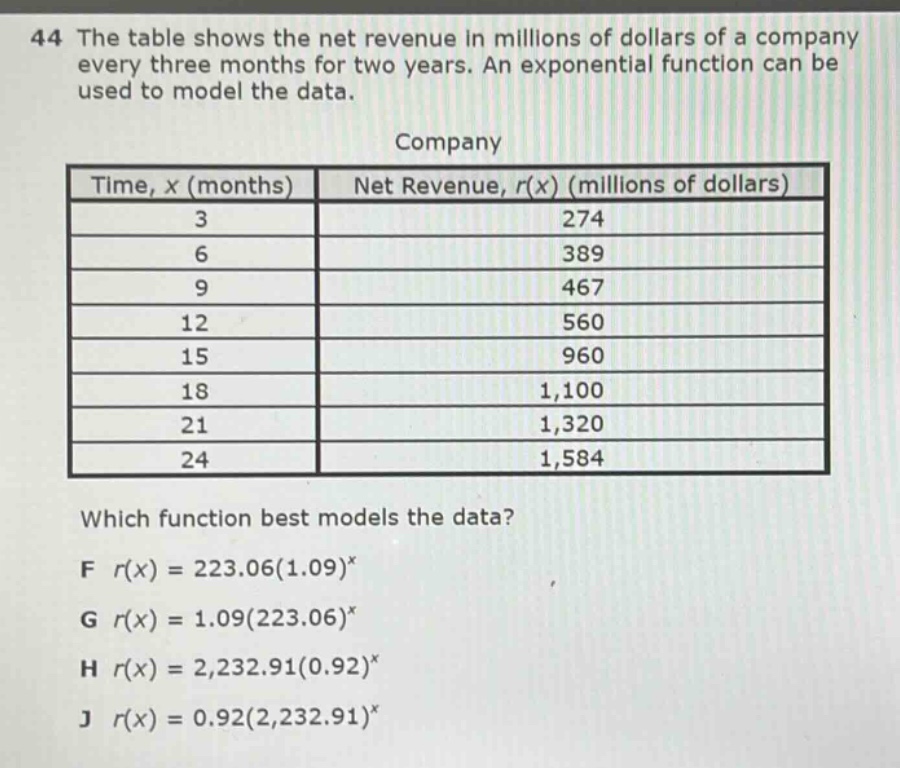
44 the table shows the net revenue in millions of dollars of a company every three months for two years. an exponential function can be used to model the data. company time, x (months) net revenue, r(x) (millions of dollars) 3 274 6 389 9 467 12 560 15 960 18 1,100 21 1,320 24 1,584 which function best models the data? f r(x) = 223.06(1.09)^x g r(x) = 1.09(223.06)^x h r(x) = 2,232.91(0.92)^x j r(x) = 0.92(2,232.91)^x
Answer
Explanation:
Step1: Recall exponential - function form
The general form of an exponential function is $r(x)=a(b)^{x}$, where $a$ is the initial - value and $b$ is the growth/decay factor. When $b>1$, it is a growth function; when $0 < b<1$, it is a decay function. Since the net revenue is increasing as time $x$ increases, $b > 1$. So we can eliminate functions H and J because in H, $b = 0.92<1$ and in J, $b = 0.92<1$.
Step2: Test function F and G with a data - point
Let's use the first data - point $(x = 3,r(x)=274)$. For function F: $r(x)=223.06(1.09)^{x}$. When $x = 3$, $r(3)=223.06\times(1.09)^{3}=223.06\times1.295029\approx290.8$. For function G: $r(x)=1.09(223.06)^{x}$. When $x = 3$, $r(3)=1.09\times(223.06)^{3}$. $(223.06)^{3}=223.06\times223.06\times223.06\approx11197977.9$, and $1.09\times(223.06)^{3}$ is a very large number, much larger than 274.
Answer:
F. $r(x)=223.06(1.09)^{x}$