an account with a $250 balance accrues 2% annually. if no deposits or withdrawals are made, which graph can…
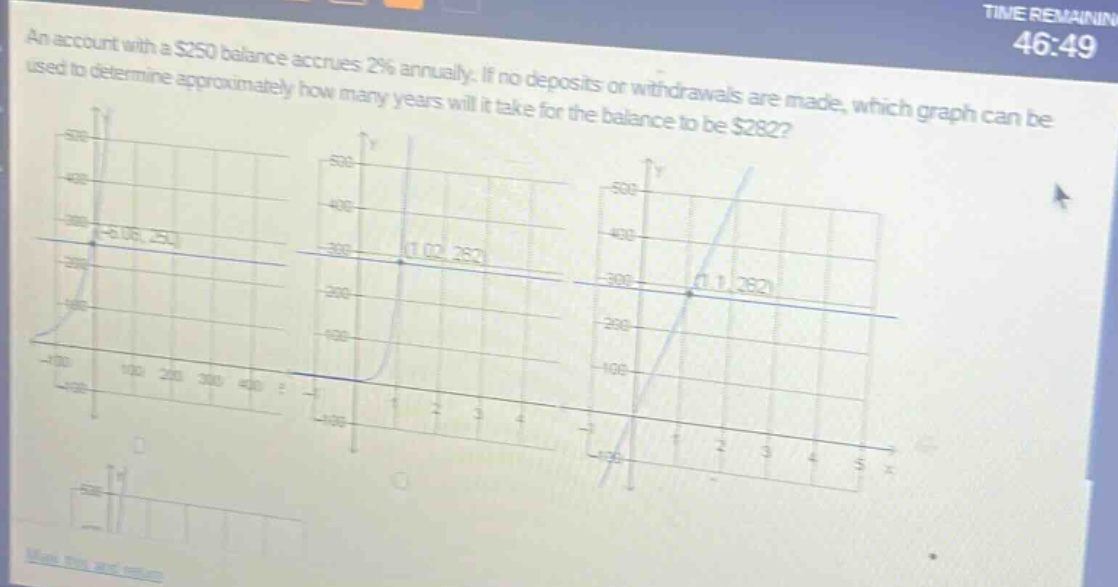
an account with a $250 balance accrues 2% annually. if no deposits or withdrawals are made, which graph can be used to determine approximately how many years will it take for the balance to be $282?
Answer
Explanation:
Step1: Identify the compound - interest formula
The compound - interest formula is $A = P(1 + r)^t$, where $A$ is the final amount, $P$ is the principal amount, $r$ is the annual interest rate (as a decimal), and $t$ is the number of years. Here, $P=$250$, $r = 0.02$, and $A=$282$. So the equation becomes $282=250(1 + 0.02)^t$.
Step2: Rearrange the equation
First, divide both sides of the equation by 250: $\frac{282}{250}=(1.02)^t$, which simplifies to $1.128=(1.02)^t$.
Step3: Take the natural logarithm of both sides
$\ln(1.128)=t\ln(1.02)$.
Step4: Solve for $t$
$t=\frac{\ln(1.128)}{\ln(1.02)}\approx\frac{0.119}{0.0198}\approx6$.
We can also analyze the graphs. The function representing the account balance is $y = 250(1.02)^x$, which is an exponential growth function of the form $y = ab^x$ with $a = 250$ and $b=1.02$. When $x = 0$, $y = 250$, and we are looking for the $x$ - value when $y = 282$.
We need to find the graph of $y = 250(1.02)^x$ and see where it intersects the line $y = 282$. The correct graph should have the initial point $(0,250)$ and show exponential growth.
Answer:
The graph that has an initial value of 250 (when $x = 0$) and shows exponential growth and intersects the line $y = 282$ at approximately $x = 6$.