barrys bagel emporium sells a dozen bagels for $5.00. this price is no longer high enough to create a…
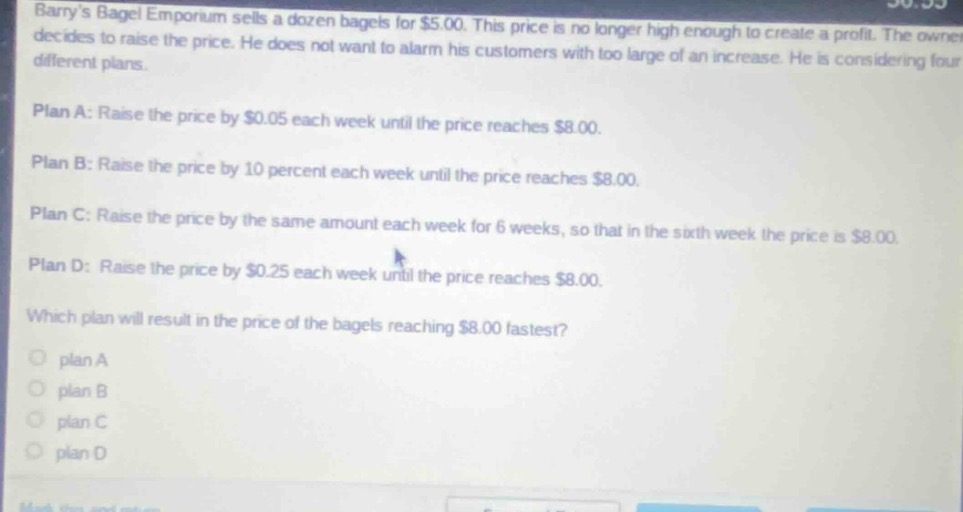
barrys bagel emporium sells a dozen bagels for $5.00. this price is no longer high enough to create a profit. the owner decides to raise the price. he does not want to alarm his customers with too large of an increase. he is considering four different plans.\nplan a: raise the price by $0.05 each week until the price reaches $8.00.\nplan b: raise the price by 10 percent each week until the price reaches $8.00.\nplan c: raise the price by the same amount each week for 6 weeks, so that in the sixth week the price is $8.00.\nplan d: raise the price by $0.25 each week until the price reaches $8.00.\nwhich plan will result in the price of the bagels reaching $8.00 fastest?\nplan a\nplan b\nplan c\nplan d
Answer
Explanation:
Step1: Calculate weeks for Plan A
Initial price $P_0 = 5$, increase per week $\Delta P_A=0.05$, target price $P = 8$. Let number of weeks be $n_A$. We use the formula $P = P_0 + n_A\Delta P_A$. So $n_A=\frac{P - P_0}{\Delta P_A}=\frac{8 - 5}{0.05}=\frac{3}{0.05}=60$.
Step2: Calculate weeks for Plan B
We use the compound - growth formula $P = P_0(1 + r)^n$, where $P_0 = 5$, $r=0.1$, $P = 8$. So $8 = 5(1 + 0.1)^n_B$, then $(1.1)^{n_B}=\frac{8}{5}=1.6$. Taking the natural logarithm of both sides, $n_B\ln(1.1)=\ln(1.6)$. So $n_B=\frac{\ln(1.6)}{\ln(1.1)}\approx\frac{0.4700036292}{0.0953101798}\approx4.93$. Since we are dealing with whole weeks, we need to round up to $n_B = 5$.
Step3: Calculate weeks for Plan C
Initial price $P_0 = 5$, target price $P = 8$ in $n_C = 6$ weeks. But we are interested in when it first reaches 8. Let the increase per week be $\Delta P_C$. Using $P=P_0 + n_C\Delta P_C$, we find $\Delta P_C=\frac{8 - 5}{6}=0.5$. In the 6th week it reaches 8, so it takes 6 weeks.
Step4: Calculate weeks for Plan D
Initial price $P_0 = 5$, increase per week $\Delta P_D = 0.25$, target price $P = 8$. Let number of weeks be $n_D$. Using $P = P_0 + n_D\Delta P_D$, we have $n_D=\frac{8 - 5}{0.25}=\frac{3}{0.25}=12$.
Answer:
B. plan B