beth has $100 to invest. she can invest this into a 7% simple interest account or into an account with 5%…
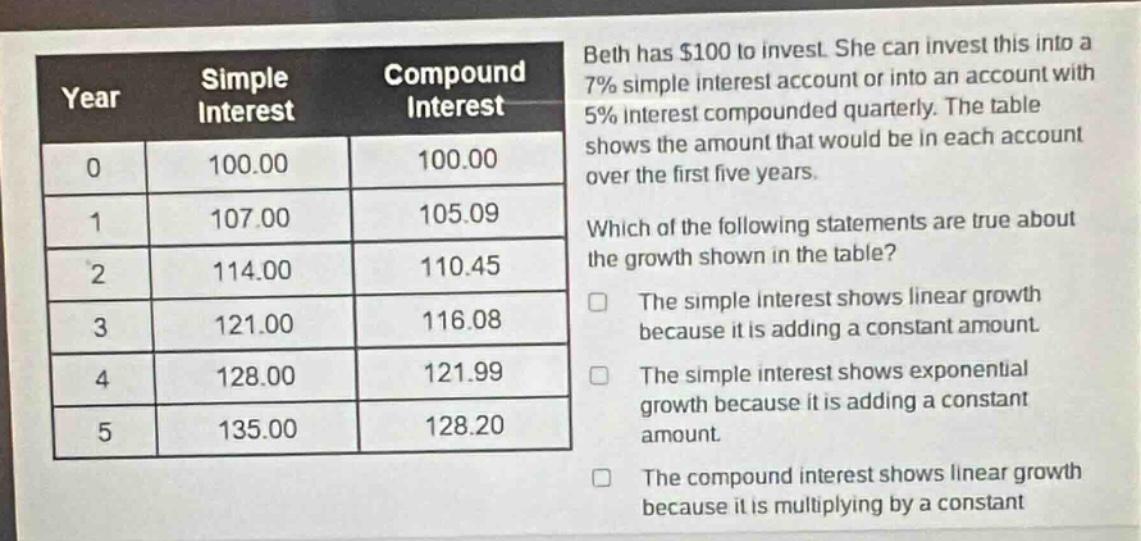
beth has $100 to invest. she can invest this into a 7% simple interest account or into an account with 5% interest compounded quarterly. the table shows the amount that would be in each account over the first five years. which of the following statements are true about the growth shown in the table? the simple interest shows linear growth because it is adding a constant amount. the simple interest shows exponential growth because it is adding a constant amount. the compound interest shows linear growth because it is multiplying by a constant
Answer
Answer:
The simple interest shows linear growth because it is adding a constant amount.
Explanation:
Step1: Analyze simple - interest growth
In simple interest, the formula is $A = P(1+rt)$ where $P = 100$, $r=0.07$. Each year, the interest earned is $I = Pr=100\times0.07 = 7$. So the amount in the account increases by a constant $7$ each year. This is the characteristic of linear growth (a constant - rate of change).
Step2: Analyze compound - interest growth
In compound interest, the formula is $A=P(1 +\frac{r}{n})^{nt}$, where $P = 100$, $r = 0.05$, $n=4$. The amount in the account is multiplied by $(1+\frac{0.05}{4})$ each quarter. This results in exponential growth, not linear growth as the amount of increase is not constant but depends on the previous amount in the account.