calvin deposits $400 in a savings account that accrues 5% interest compounded monthly. after c years, calvin…
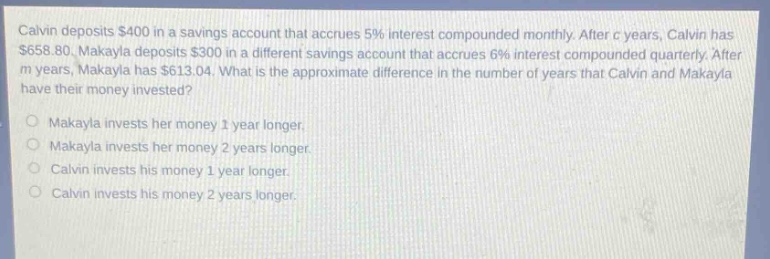
calvin deposits $400 in a savings account that accrues 5% interest compounded monthly. after c years, calvin has $658.80. makayla deposits $300 in a different savings account that accrues 6% interest compounded quarterly. after m years, makayla has $613.04. what is the approximate difference in the number of years that calvin and makayla have their money invested? makayla invests her money 1 year longer. makayla invests her money 2 years longer. calvin invests his money 1 year longer. calvin invests his money 2 years longer.
Answer
Explanation:
Step1: Use compound - interest formula for Calvin
The compound - interest formula is $A = P(1+\frac{r}{n})^{nt}$, where $A$ is the final amount, $P$ is the principal amount, $r$ is the annual interest rate (in decimal), $n$ is the number of times interest is compounded per year, and $t$ is the number of years. For Calvin, $P = 400$, $r=0.05$, $n = 12$, and $A = 658.80$. So, $658.80=400(1 +\frac{0.05}{12})^{12c}$. First, divide both sides by 400: $\frac{658.80}{400}=(1+\frac{0.05}{12})^{12c}$. $1.647=(1+\frac{0.05}{12})^{12c}$. Take the natural logarithm of both sides: $\ln(1.647)=12c\ln(1+\frac{0.05}{12})$. Since $1+\frac{0.05}{12}=1+\frac{1}{240}=\frac{241}{240}$, $\ln(1+\frac{0.05}{12})\approx\ln(1.004167)\approx0.00416$. $\ln(1.647)\approx0.498$. Then $c=\frac{\ln(1.647)}{12\ln(1+\frac{0.05}{12})}=\frac{0.498}{12\times0.00416}\approx10$.
Step2: Use compound - interest formula for Makayla
For Makayla, $P = 300$, $r = 0.06$, $n = 4$, and $A = 613.04$. So, $613.04=300(1+\frac{0.06}{4})^{4m}$. Divide both sides by 300: $\frac{613.04}{300}=(1 +\frac{0.06}{4})^{4m}$. $2.0435=(1+\frac{0.06}{4})^{4m}$. Take the natural logarithm of both sides: $\ln(2.0435)=4m\ln(1+\frac{0.06}{4})$. Since $1+\frac{0.06}{4}=1.015$, $\ln(1.015)\approx0.0149$. $\ln(2.0435)\approx0.714$. Then $m=\frac{\ln(2.0435)}{4\ln(1.015)}=\frac{0.714}{4\times0.0149}\approx12$.
Step3: Find the difference in years
The difference in the number of years is $m - c=12 - 10 = 2$. Makayla invests her money 2 years longer.
Answer:
Makayla invests her money 2 years longer.