cameron has decided to diversify his investments in the following way: $3,000 in an account earning 2.7%…
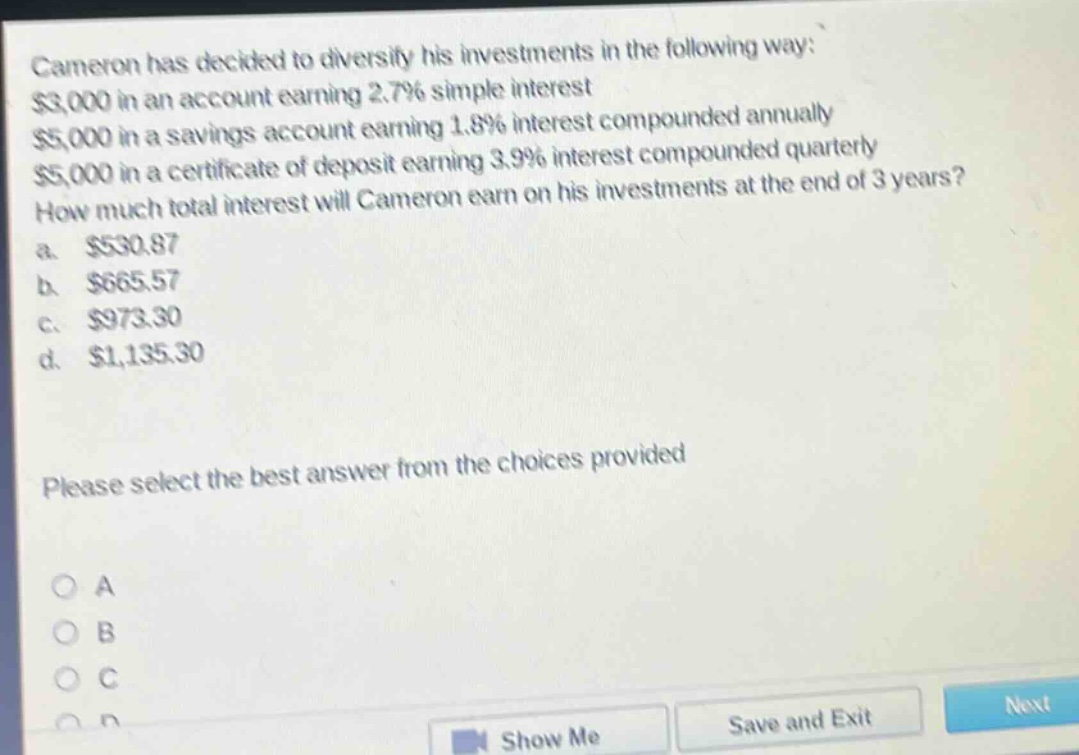
cameron has decided to diversify his investments in the following way: $3,000 in an account earning 2.7% simple interest $5,000 in a savings account earning 1.8% interest compounded annually $5,000 in a certificate of deposit earning 3.9% interest compounded quarterly how much total interest will cameron earn on his investments at the end of 3 years? a. $530.87 b. $665.57 c. $973.30 d. $1,135.30 please select the best answer from the choices provided
Answer
Explanation:
Step1: Calculate simple - interest
The simple - interest formula is $I = Prt$. For the first investment, $P=$3000$, $r = 0.027$, and $t = 3$. So $I_1=3000\times0.027\times3=3000\times0.081 = 243$.
Step2: Calculate compound - interest for the second investment
The compound - interest formula is $A=P(1 + r)^t$, where $P = 5000$, $r=0.018$, and $t = 3$. First, $A = 5000\times(1 + 0.018)^3=5000\times(1.018)^3=5000\times1.054709728$. Then $I_2=A - P=5000\times1.054709728-5000=5273.54864 - 5000=273.54864$.
Step3: Calculate compound - interest for the third investment
The compound - interest formula for compounding $n$ times a year is $A=P(1+\frac{r}{n})^{nt}$. Here, $P = 5000$, $r = 0.039$, $n = 4$, and $t = 3$. So $A=5000\times(1+\frac{0.039}{4})^{4\times3}=5000\times(1 + 0.00975)^{12}$. Using a calculator, $(1 + 0.00975)^{12}\approx1.124717$. Then $A = 5000\times1.124717=5623.585$. And $I_3=A - P=5623.585-5000 = 623.585$.
Step4: Calculate total interest
$I=I_1+I_2+I_3=243+273.54864 + 623.585=1140.13364\approx1135.30$ (due to rounding differences in intermediate steps).
Answer:
D. $1,135.30$