a certain company has a fixed cost of $200 per day. it costs the company $3.10 per unit to make its…
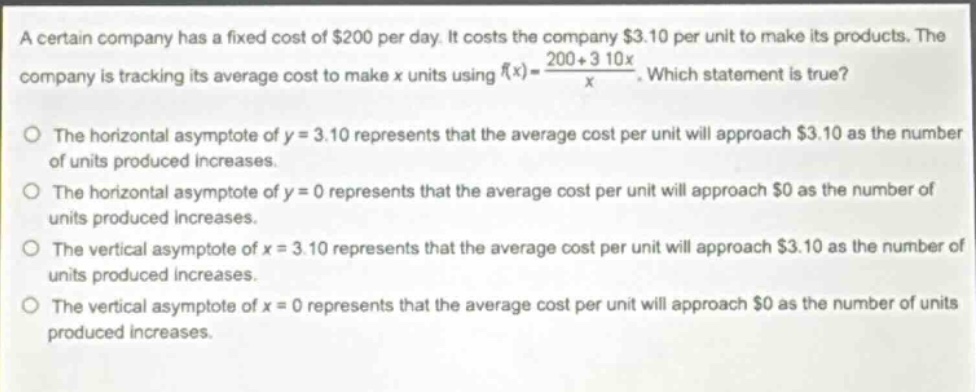
a certain company has a fixed cost of $200 per day. it costs the company $3.10 per unit to make its products. the company is tracking its average cost to make x units using $f(x)=\frac{200 + 3.10x}{x}$. which statement is true?\no the horizontal asymptote of y = 3.10 represents that the average cost per unit will approach $3.10 as the number of units produced increases.\no the horizontal asymptote of y = 0 represents that the average cost per unit will approach $0 as the number of units produced increases.\no the vertical asymptote of x = 3.10 represents that the average cost per unit will approach $3.10 as the number of units produced increases.\no the vertical asymptote of x = 0 represents that the average cost per unit will approach $0 as the number of units produced increases.
Answer
Explanation:
Step1: Recall asymptote concepts
For a rational function $f(x)=\frac{a + bx}{x}=\frac{a}{x}+b$ (where $a = 200$, $b = 3.10$), vertical asymptotes occur where the denominator is zero, and horizontal asymptotes are determined by the behavior as $x\to\pm\infty$.
Step2: Find vertical asymptote
Set the denominator of $f(x)=\frac{200 + 3.10x}{x}$ equal to zero. So $x = 0$ is the vertical - asymptote. But this has nothing to do with the average cost approaching a value as the number of units produced increases.
Step3: Find horizontal asymptote
As $x\to\pm\infty$, $\lim_{x\to\pm\infty}\frac{200+3.10x}{x}=\lim_{x\to\pm\infty}(\frac{200}{x}+3.10)$. Since $\lim_{x\to\pm\infty}\frac{200}{x}=0$, then $\lim_{x\to\pm\infty}\frac{200 + 3.10x}{x}=3.10$. This means the average cost per unit will approach $$3.10$ as the number of units produced increases.
Answer:
The horizontal asymptote of $y = 3.10$ represents that the average cost per unit will approach $$3.10$ as the number of units produced increases.