claire deposited $2,500 into an account that accrues interest monthly. she made no additional deposits or…
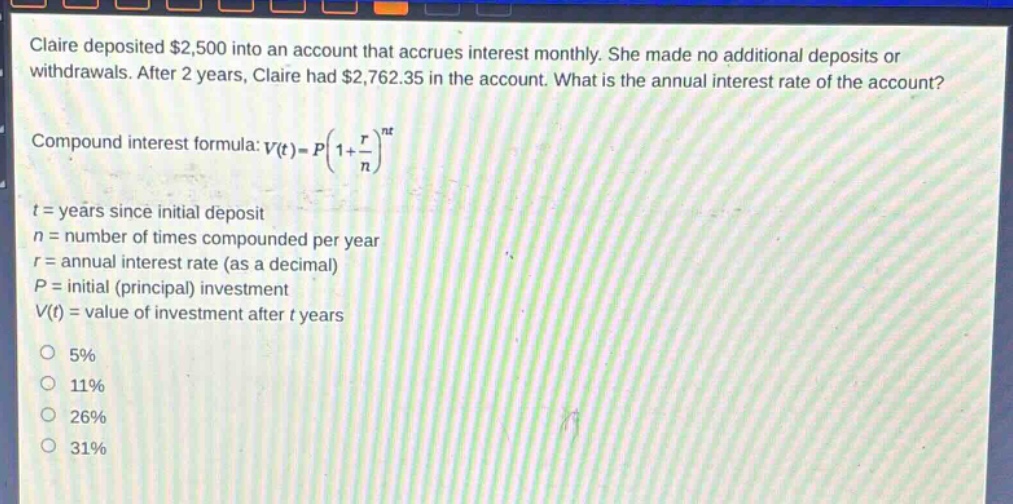
claire deposited $2,500 into an account that accrues interest monthly. she made no additional deposits or withdrawals. after 2 years, claire had $2,762.35 in the account. what is the annual interest rate of the account? compound interest formula: $v(t)=p(1 + \\frac{r}{n})^{nt}$\n$t$ = years since initial deposit\n$n$ = number of times compounded per year\n$r$ = annual interest rate (as a decimal)\n$p$ = initial (principal) investment\n$v(t)$ = value of investment after $t$ years\n5%\n11%\n26%\n31%
Answer
Explanation:
Step1: Identify the given values
$P = 2500$, $V(t)=2762.35$, $t = 2$, $n=12$
Step2: Substitute values into the compound - interest formula
$2762.35=2500\left(1 +\frac{r}{12}\right)^{12\times2}$
Step3: Divide both sides by 2500
$\frac{2762.35}{2500}=\left(1 +\frac{r}{12}\right)^{24}$ $1.10494=\left(1 +\frac{r}{12}\right)^{24}$
Step4: Take the 24th root of both sides
$1.10494^{\frac{1}{24}}=1+\frac{r}{12}$ $1.004167 = 1+\frac{r}{12}$
Step5: Subtract 1 from both sides
$1.004167−1=\frac{r}{12}$ $0.004167=\frac{r}{12}$
Step6: Solve for r
$r=0.004167\times12$ $r = 0.05$ or $5%$
Answer:
$5%$