c.b. clothing ordered sweaters at a wholesale cost of $20 each. the store marked up the price 50 percent…
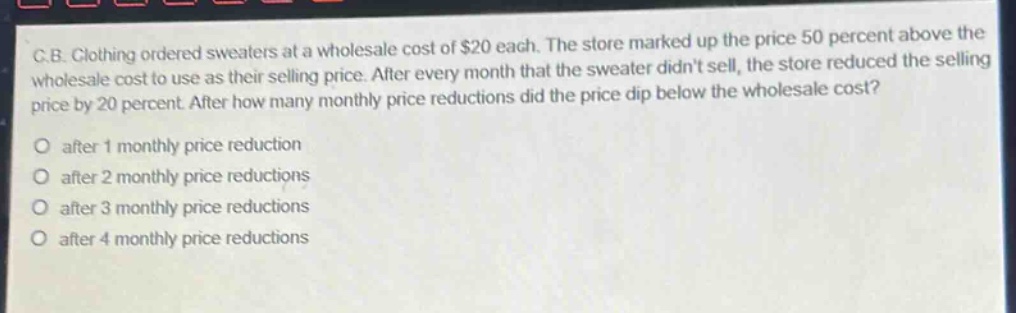
c.b. clothing ordered sweaters at a wholesale cost of $20 each. the store marked up the price 50 percent above the wholesale cost to use as their selling price. after every month that the sweater didnt sell, the store reduced the selling price by 20 percent. after how many monthly price reductions did the price dip below the wholesale cost?\no after 1 monthly price reduction\no after 2 monthly price reductions\no after 3 monthly price reductions\no after 4 monthly price reductions
Answer
Explanation:
Step1: Calculate the marked - up selling price
The wholesale cost is $20. The marked - up price is $20\times(1 + 50%)=20\times1.5 = 30$.
Step2: Set up the formula for the price after $n$ monthly reductions
The price after $n$ monthly 20% reductions is $P = 30\times(1 - 20%)^n=30\times0.8^n$.
Step3: Find the value of $n$ when $P<20$
We need to solve the inequality $30\times0.8^n<20$. First, rewrite it as $0.8^n<\frac{20}{30}=\frac{2}{3}\approx0.667$. When $n = 1$, $0.8^1=0.8>0.667$. When $n = 2$, $0.8^2 = 0.64<0.667$.
Answer:
after 2 monthly price reductions