company a 10 per hr. 20 per hr.\ncompany b 10 per hr. 25 per hr.\ncompany c 15 per hr. 15 per hr.\ncompany d…
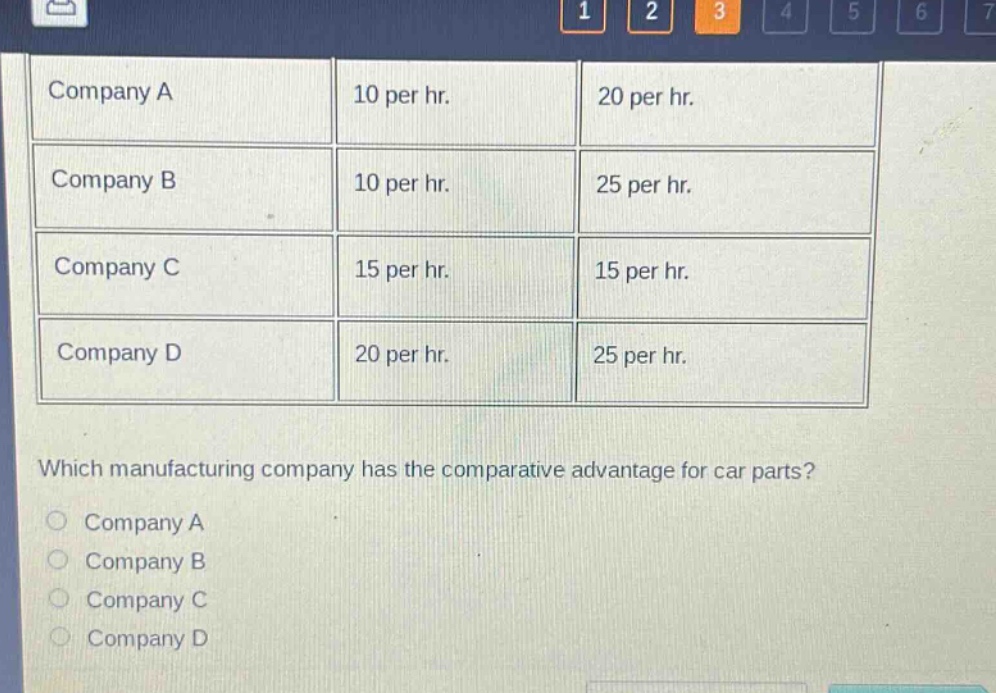
company a 10 per hr. 20 per hr.\ncompany b 10 per hr. 25 per hr.\ncompany c 15 per hr. 15 per hr.\ncompany d 20 per hr. 25 per hr.\nwhich manufacturing company has the comparative advantage for car parts?\ncompany a\ncompany b\ncompany c\ncompany d
Answer
Answer:
We need more information to determine the answer as the table does not clearly define what the "10 per hr.", "20 per hr." etc. represent in terms of car - part production (e.g., cost of production, output per hour). Without this key information, we cannot calculate or compare the opportunity costs to find the company with comparative advantage. So, the problem as presented is incomplete.
Explanation:
Step1: Analyze the table
The table shows hourly rates for four companies but no context on what these rates mean for car - part production.
Step2: Recall the concept of comparative advantage
Comparative advantage is determined by lower opportunity cost. We need data on production or cost related to car parts to calculate opportunity costs. Since this data is missing, we cannot answer the question.