consider the tables created using an initial investment of $1,000 and quarterly compounding of interest…
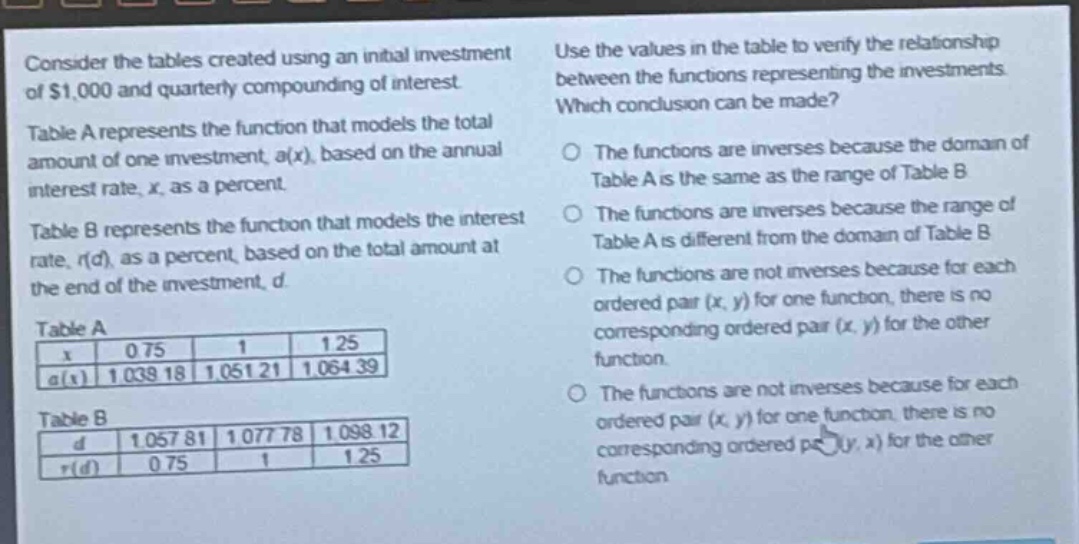
consider the tables created using an initial investment of $1,000 and quarterly compounding of interest. table a represents the function that models the total amount of one investment, a(x), based on the annual interest rate, x, as a percent. table b represents the function that models the interest rate, r(d), as a percent, based on the total amount at the end of the investment, d. table a: x 0.75 1 1.25; a(x) 1.03818 1.05121 1.06439. table b: d 1.05781 1.07778 1.09812; r(d) 0.75 1 1.25. use the values in the table to verify the relationship between the functions representing the investments. which conclusion can be made? the functions are inverses because the domain of table a is the same as the range of table b. the functions are inverses because the range of table a is different from the domain of table b. the functions are not inverses because for each ordered pair (x, y) for one function, there is no corresponding ordered pair (x, y) for the other function. the functions are not inverses because for each ordered pair (x, y) for one function, there is no corresponding ordered pair (y, x) for the other function.
Answer
Explanation:
Step1: Recall inverse - function property
For two functions (f(x)) and (g(x)) to be inverses, if ((x,y)) is a point on (f(x)), then ((y,x)) must be a point on (g(x)).
Step2: Analyze the ordered - pairs in Table A and Table B
In Table A, we have ordered pairs ((0.75,1.03818)), ((1,1.05121)), ((1.25,1.06439)). In Table B, we have ordered pairs ((1.05781,0.75)), ((1.07778,1)), ((1.09812,1.25)). We can see that for the ordered pairs ((x,y)) in Table A, there is no corresponding ((y,x)) in Table B.
Answer:
The functions are not inverses because for each ordered pair ((x,y)) for one function, there is no corresponding ordered pair ((y,x)) for the other function.