a consumer protection group randomly checks the volume of different beverages to ensure that companies are…
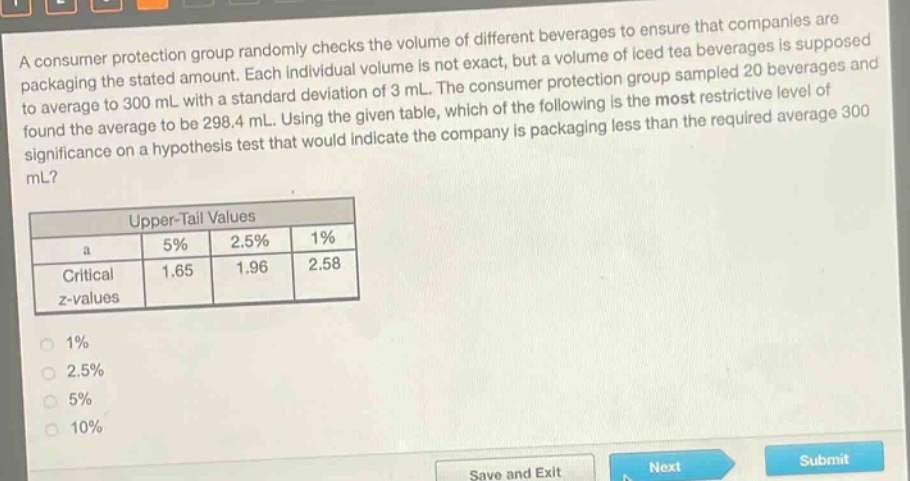
a consumer protection group randomly checks the volume of different beverages to ensure that companies are packaging the stated amount. each individual volume is not exact, but a volume of iced tea beverages is supposed to average to 300 ml with a standard deviation of 3 ml. the consumer protection group sampled 20 beverages and found the average to be 298.4 ml. using the given table, which of the following is the most restrictive level of significance on a hypothesis test that would indicate the company is packaging less than the required average 300 ml?\n\n| upper - tail values | | | |\n| ---- | ---- | ---- | ---- |\n| a | 5% | 2.5% | 1% |\n| critical z - values | 1.65 | 1.96 | 2.58 |\n\n1% \n2.5% \n5% \n10%
Answer
Answer:
1%
Explanation:
Step1: Calculate the z - score
The formula for the z - score in a sampling distribution is $z=\frac{\bar{x}-\mu}{\frac{\sigma}{\sqrt{n}}}$, where $\bar{x} = 298.4$ (sample mean), $\mu=300$ (population mean), $\sigma = 3$ (standard deviation) and $n = 20$ (sample size). First, calculate $\frac{\sigma}{\sqrt{n}}=\frac{3}{\sqrt{20}}\approx0.6708$. Then $z=\frac{298.4 - 300}{0.6708}=\frac{- 1.6}{0.6708}\approx - 2.385$.
Step2: Determine the significance level
For a one - tailed test (company is packaging less than the required average), we want to find the significance level such that the critical z - value is just more negative than our calculated z - value. Looking at the upper - tail values table, for a 1% significance level in a one - tailed test, the critical z - value for the lower tail is approximately $- 2.33$ (since for upper - tail 1% the z - value is 2.58 for two - tailed and 2.33 for one - tailed). Our calculated z - value of approximately $- 2.385$ is more negative than the critical z - value for 1% significance level in a one - tailed test. So the most restrictive level of significance is 1%.