1.) decision making using probabilities - i (using expected value criterion)\n• beth perry purchases…
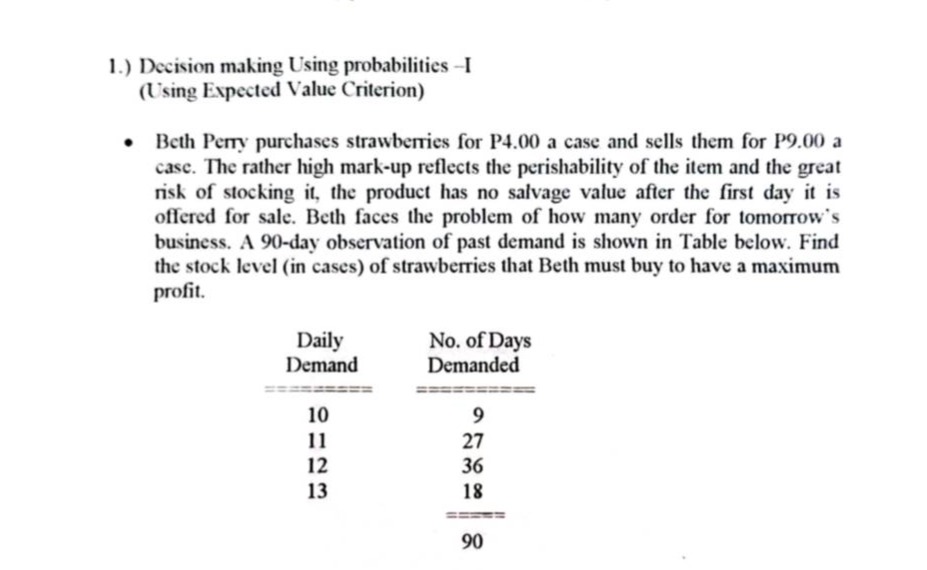
1.) decision making using probabilities - i (using expected value criterion)\n• beth perry purchases strawberries for p4.00 a case and sells them for p9.00 a case. the rather high mark - up reflects the perishability of the item and the great risk of stocking it, the product has no salvage value after the first day it is offered for sale. beth faces the problem of how many order for tomorrows business. a 90 - day observation of past demand is shown in table below. find the stock level (in cases) of strawberries that beth must buy to have a maximum profit.\n\n| daily demand | no. of days demanded |\n| ---- | ---- |\n| 10 | 9 |\n| 11 | 27 |\n| 12 | 36 |\n| 13 | 18 |\n| | 90 |
Answer
Explanation:
Step1: Calculate probabilities
The probability of a demand level is the number of days demanded divided by the total number of days. For demand of 10 cases: $P(10)=\frac{9}{90} = 0.1$ For demand of 11 cases: $P(11)=\frac{27}{90}=0.3$ For demand of 12 cases: $P(12)=\frac{36}{90}=0.4$ For demand of 13 cases: $P(13)=\frac{18}{90}=0.2$
Step2: Calculate expected - value of profit for different stock - levels
Let $x$ be the stock - level and $d$ be the demand. The profit function is $Profit=(9 - 4)min(x,d)-4(max(0,x - d))$.
Case 1: Stock 10 cases
The profit is always $(9 - 4)\times10=50$ (since demand is always at least 10). $E(Profit_{10})=50$
Case 2: Stock 11 cases
$E(Profit_{11})=5\times10\times0.1+5\times11\times(0.3 + 0.4+0.2)$ $=5\times10\times0.1+5\times11\times0.9$ $=5 + 49.5=54.5$
Case 3: Stock 12 cases
$E(Profit_{12})=5\times10\times0.1+5\times11\times0.3+5\times12\times(0.4 + 0.2)$ $=5+16.5 + 36$ $=57.5$
Case 4: Stock 13 cases
$E(Profit_{13})=5\times10\times0.1+5\times11\times0.3+5\times12\times0.4+5\times13\times0.2$ $=5+16.5+24 + 13$ $=58.5$
Answer:
13