devon purchased a new car valued at $16,000 that depreciated continuously at a rate of 35%. its current…
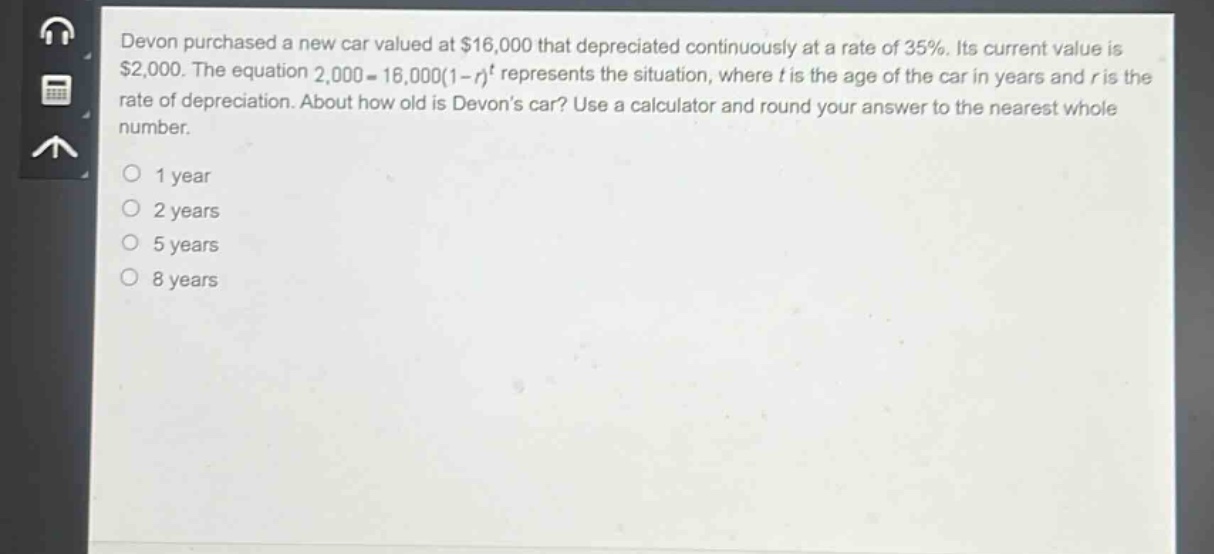
devon purchased a new car valued at $16,000 that depreciated continuously at a rate of 35%. its current value is $2,000. the equation 2,000 = 16,000(1 - r)^t represents the situation, where t is the age of the car in years and r is the rate of depreciation. about how old is devons car? use a calculator and round your answer to the nearest whole number.\n1 year\n2 years\n5 years\n8 years
Answer
Answer:
C. 5 years
Explanation:
Step1: Substitute values into equation
Given $r = 0.35$, the equation becomes $2000=16000(1 - 0.35)^t$, which simplifies to $2000 = 16000\times0.65^t$.
Step2: Isolate the exponential term
Divide both sides by 16000: $\frac{2000}{16000}=0.65^t$, so $0.125 = 0.65^t$.
Step3: Take the natural - log of both sides
$\ln(0.125)=\ln(0.65^t)$. Using the property $\ln(a^b)=b\ln(a)$, we get $\ln(0.125)=t\ln(0.65)$.
Step4: Solve for t
$t=\frac{\ln(0.125)}{\ln(0.65)}$. Calculate $\ln(0.125)\approx - 2.079442$ and $\ln(0.65)\approx - 0.430783$. Then $t=\frac{-2.079442}{-0.430783}\approx4.83$. Rounding to the nearest whole number, $t = 5$.