the equation for the future value of a deposit earning compound interest is $v(t)=p(1 + \\frac{r}{n})^{nt}$…
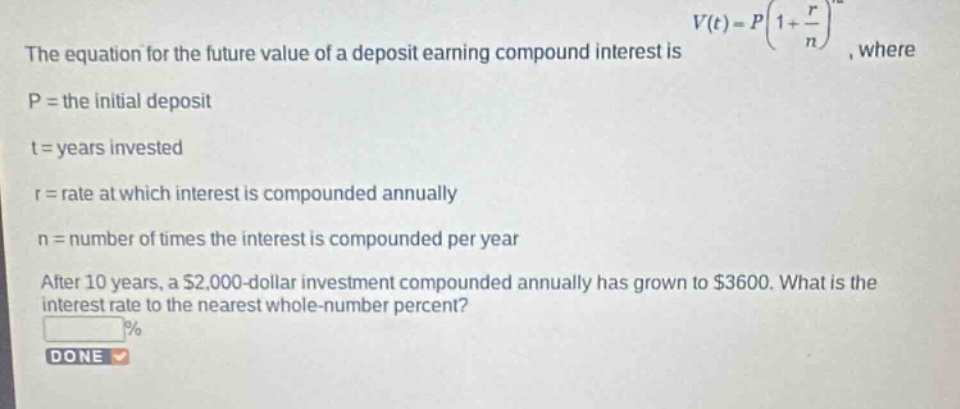
the equation for the future value of a deposit earning compound interest is $v(t)=p(1 + \\frac{r}{n})^{nt}$, where\np = the initial deposit\nt = years invested\nr = rate at which interest is compounded annually\nn = number of times the interest is compounded per year\nafter 10 years, a $2,000 - dollar investment compounded annually has grown to $3600. what is the interest rate to the nearest whole - number percent?\n%
Answer
Explanation:
Step1: Identify given values
$P = 2000$, $V(t)=3600$, $t = 10$, $n = 1$
Step2: Substitute values into formula
$3600=2000\left(1 + \frac{r}{1}\right)^{1\times10}$
Step3: Simplify the equation
$\frac{3600}{2000}=(1 + r)^{10}$ $1.8=(1 + r)^{10}$
Step4: Solve for $r$
Take the 10 - th root of both sides: $1 + r=1.8^{\frac{1}{10}}$ $1 + r\approx1.06054$ $r\approx1.06054 - 1$ $r\approx0.06054$
Step5: Convert to percentage
$r\approx6.054%$ Rounding to the nearest whole - number percent, $r\approx6%$
Answer:
$6$