find the interest earned. assume 3 1/2% interest compounded daily. assume a non - leap year. amount date…
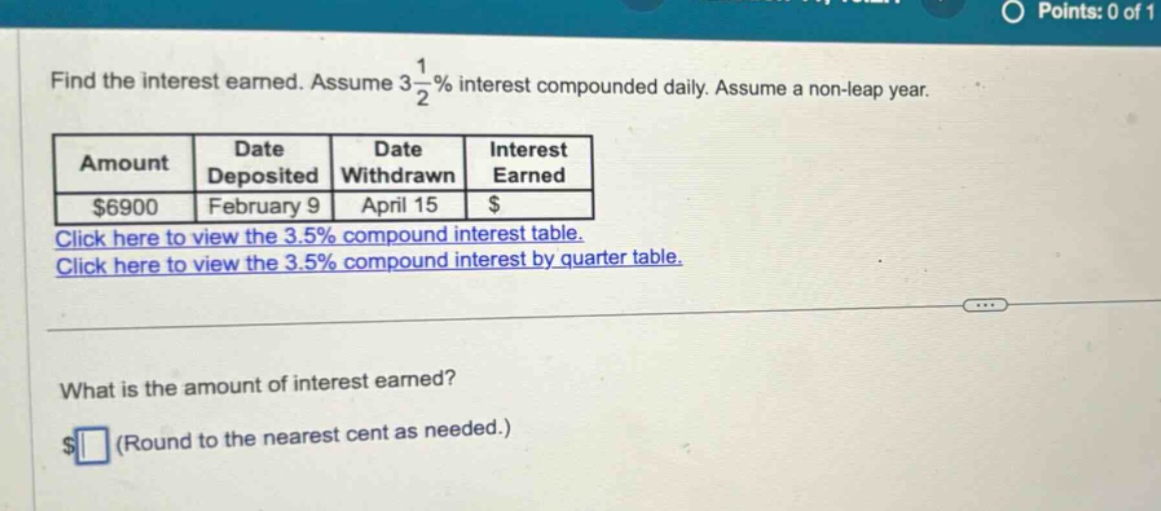
find the interest earned. assume 3 1/2% interest compounded daily. assume a non - leap year. amount date deposited date withdrawn interest earned $6900 february 9 april 15 $ click here to view the 3.5% compound interest table. click here to view the 3.5% compound interest by quarter table. what is the amount of interest earned? $ (round to the nearest cent as needed.)
Answer
Explanation:
Step1: Calculate number of days
February has 28 days (non - leap year). From February 9 to February 28, there are $28 - 9=19$ days. March has 31 days. From April 1 to April 15, there are 15 days. So the total number of days $n=19 + 31+15 = 65$ days.
Step2: Convert annual interest rate
The annual interest rate $r = 3.5%=0.035$. The daily interest rate $i=\frac{r}{365}=\frac{0.035}{365}$.
Step3: Use compound - interest formula
The compound - interest formula for daily compounding is $A = P(1 + i)^n$, where $P=$6900$, $i=\frac{0.035}{365}$, and $n = 65$. First, calculate $(1 + i)^n=(1+\frac{0.035}{365})^{65}$. Then $A = 6900\times(1+\frac{0.035}{365})^{65}$. The interest earned $I=A - P$. $(1+\frac{0.035}{365})^{65}\approx1+\frac{0.035\times65}{365}$ (using the approximation $(1 + x)^n\approx1+nx$ for small $x$). $(1+\frac{0.035}{365})^{65}\approx1+\frac{2.275}{365}\approx1 + 0.00623288$. $A = 6900\times(1+\frac{0.035}{365})^{65}\approx6900\times1.00623288=$6943.4068$. $I=A - P=6943.4068 - 6900=$43.41$
Answer:
$43.41$