2. harvard professor cass sunstein and university of chicago professor richard thaler introduced the concept…
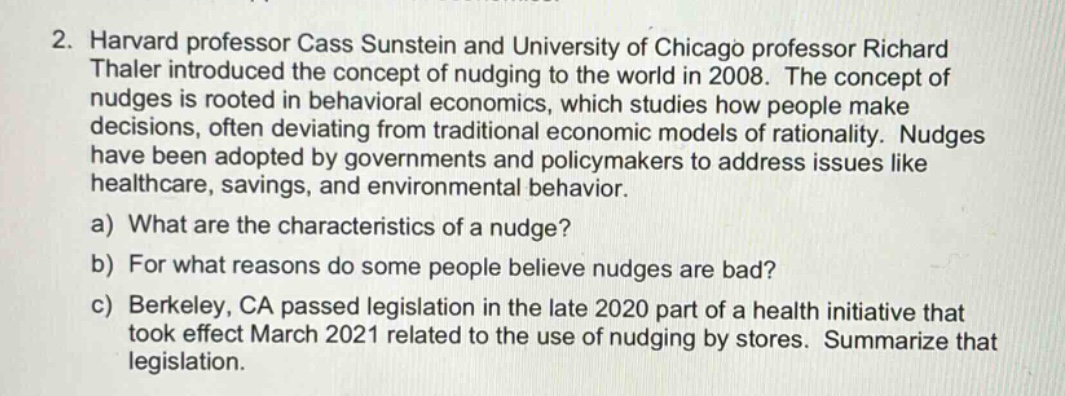
2. harvard professor cass sunstein and university of chicago professor richard thaler introduced the concept of nudging to the world in 2008. the concept of nudges is rooted in behavioral economics, which studies how people make decisions, often deviating from traditional economic models of rationality. nudges have been adopted by governments and policymakers to address issues like healthcare, savings, and environmental behavior. a) what are the characteristics of a nudge? b) for what reasons do some people believe nudges are bad? c) berkeley, ca passed legislation in the late 2020 part of a health initiative that took effect march 2021 related to the use of nudging by stores. summarize that legislation.
Answer
Brief Explanations:
a) A nudge is a subtle influence that alters decision - making without restricting choices. It is often based on insights from behavioral economics about human cognitive biases. b) Some people believe nudges are bad because they may be seen as a form of manipulation. There are concerns about the lack of transparency in the use of nudges and the potential for undermining individual autonomy. c) Without specific information about the Berkeley legislation, a general summary could be that it likely regulated how stores could use nudging techniques in the context of promoting health - related behaviors, perhaps related to product placement, signage, or other marketing - like nudges to encourage healthier consumer choices.
Answer:
a) Subtle influence, doesn't restrict choices, based on cognitive biases. b) Seen as manipulation, lack of transparency, undermines autonomy. c) Likely regulated store nudging for health - related consumer behavior.