a high - interest savings account pays 5.5% interest compounded annually. if $300 is deposited initially and…
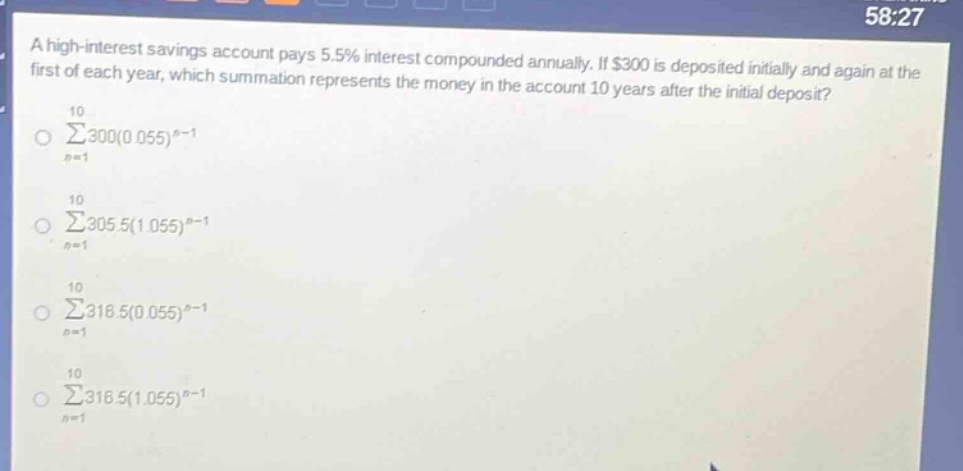
a high - interest savings account pays 5.5% interest compounded annually. if $300 is deposited initially and again at the first of each year, which summation represents the money in the account 10 years after the initial deposit?\n\\(\\sum_{n = 1}^{10}300(0.055)^{n - 1}\\)\n\\(\\sum_{n = 1}^{10}305.5(1.055)^{n - 1}\\)\n\\(\\sum_{n = 1}^{10}316.5(0.055)^{n - 1}\\)\n\\(\\sum_{n = 1}^{10}316.5(1.055)^{n - 1}\\)
Answer
Answer:
D. $\sum_{n = 1}^{10}316.5(1.055)^{n - 1}$
Explanation:
Step1: Analyze the first - year deposit
The initial deposit of $300$ will earn interest for 10 years. After the first year, the value of the initial $300$ deposit is $300(1 + 0.055)=300\times1.055$. After the second year, its value is $300\times(1.055)^2$, and after $n$ years, its value is $300\times(1.055)^n$. When considering the general form of a geometric - series $\sum_{n = 1}^{N}a\times r^{n - 1}$, for the first deposit, the first - term $a_1$ of the series related to the first deposit after 10 years of compounding is $300\times1.055$ (because when $n = 1$, the value of the first - year deposit is $300\times1.055$).
Step2: Analyze subsequent deposits
For the second deposit (made at the start of the second year), it will earn interest for 9 years. Its value after 9 years of compounding is $300\times(1.055)^9$, and in the geometric - series form, when considering the series for all deposits, for the second deposit, when $n = 2$, its value contributes to the series. The annual deposit of $300$ earns interest. The amount of money in the account forms a geometric series. The first - term $a$ of the geometric series: The first deposit of $300$ after one year becomes $300\times1.055 = 316.5$. The common ratio $r$ of the geometric series is $1.055$ (since the interest rate is 5.5% compounded annually). The sum of a geometric series for $N$ terms is $\sum_{n = 1}^{N}a\times r^{n - 1}$, where $N = 10$ (10 - year period), $a=316.5$ and $r = 1.055$. So the sum that represents the money in the account 10 years after the initial deposit is $\sum_{n = 1}^{10}316.5(1.055)^{n - 1}$.