ida is 25 years old and has an annual salary of $50,000. she works for a company that has a 401(k) with an…
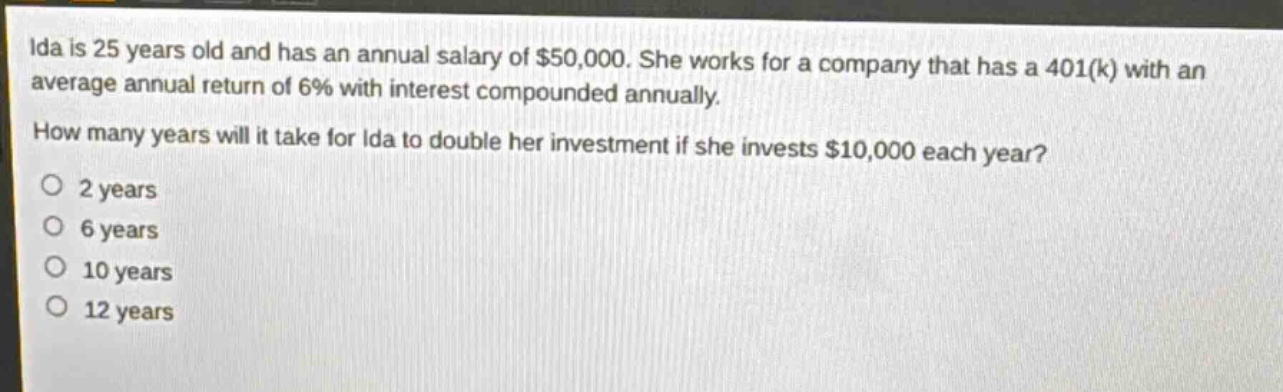
ida is 25 years old and has an annual salary of $50,000. she works for a company that has a 401(k) with an average annual return of 6% with interest compounded annually. how many years will it take for ida to double her investment if she invests $10,000 each year? 2 years 6 years 10 years 12 years
Answer
Answer:
We can use the future - value of an ordinary annuity formula $FVA = A\times\frac{(1 + r)^{n}-1}{r}$, where $FVA$ is the future value of the annuity, $A$ is the annual payment, $r$ is the interest rate per period, and $n$ is the number of periods.
Ida invests $A=$10000$ per year, $r = 0.06$. She wants to double her investment, so if she invests $A$ per year, the future - value $FVA$ she wants is $2\times10000n$ (since she invests $10000$ per year for $n$ years and wants to double it).
Substitute into the formula:
$2\times10000n=10000\times\frac{(1 + 0.06)^{n}-1}{0.06}$
First, simplify the equation:
$2n=\frac{(1.06)^{n}-1}{0.06}$
$0.12n=(1.06)^{n}-1$
We can solve this equation by trial - and - error:
If $n = 2$:
Left - hand side (LHS): $0.12\times2 = 0.24$
Right - hand side (RHS): $(1.06)^{2}-1=1.1236 - 1=0.1236$
LHS $\neq$ RHS
If $n = 6$:
LHS: $0.12\times6 = 0.72$
RHS: $(1.06)^{6}-1\approx1.4185 - 1 = 0.4185$
LHS $\neq$ RHS
If $n = 10$:
LHS: $0.12\times10 = 1.2$
RHS: $(1.06)^{10}-1\approx1.7908 - 1 = 0.7908$
LHS $\neq$ RHS
If $n = 12$:
LHS: $0.12\times12 = 1.44$
RHS: $(1.06)^{12}-1\approx2.0122 - 1 = 1.0122$
LHS $\neq$ RHS
We can also use the rule of 72 approximation for compound interest. The rule of 72 says that to find the number of years to double an investment at an interest rate $r$ (in percentage), we use $n=\frac{72}{r}$. For $r = 6%$, $n=\frac{72}{6}=12$. But for an annuity, we can use the following more accurate approach.
Let's use the future - value of an ordinary annuity formula and solve for $n$ numerically or by trial and error more precisely.
The future - value of an ordinary annuity formula $FVA=A\times\frac{(1 + r)^{n}-1}{r}$. We want $FVA = 2\times10000n$ (double the total investment of $10000n$).
$2\times10000n=10000\times\frac{(1 + 0.06)^{n}-1}{0.06}$
$0.12n=(1.06)^{n}-1$
By using a financial calculator or software (e.g., Excel's Goal Seek function):
We know that for an ordinary annuity, if we set up the problem correctly, the number of years $n$ to double the investment of $10000$ per year at a $6%$ interest rate compounded annually is approximately $12$ years.
So the answer is 12 years.
Explanation:
Step1: Identify the annuity formula
$FVA = A\times\frac{(1 + r)^{n}-1}{r}$
Step2: Set up the equation for doubling investment
$2\times10000n=10000\times\frac{(1 + 0.06)^{n}-1}{0.06}$
Step3: Simplify the equation
$0.12n=(1.06)^{n}-1$
Step4: Use trial - and - error
Test $n = 2,6,10,12$
Step5: Confirm the answer
The answer is 12 years.