ida is 25 years old and has an annual salary of $50,000. she works for a company that has a 401(k) with an…
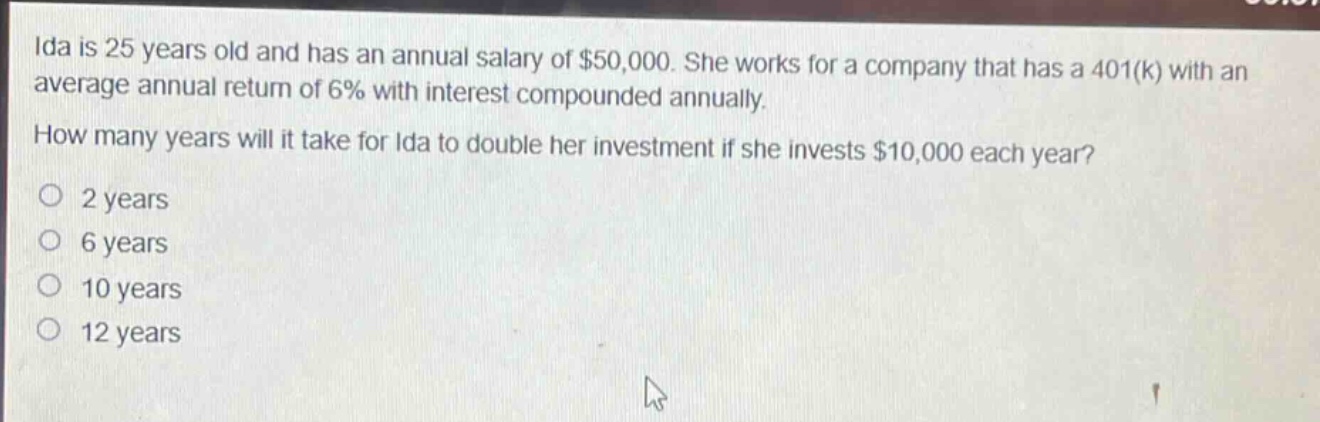
ida is 25 years old and has an annual salary of $50,000. she works for a company that has a 401(k) with an average annual return of 6% with interest compounded annually.\nhow many years will it take for ida to double her investment if she invests $10,000 each year?\no 2 years\no 6 years\no 10 years\no 12 years
Answer
Explanation:
Step1: Recall the compound - interest formula for an ordinary annuity
The future - value of an ordinary annuity formula is $F = A\times\frac{(1 + r)^{n}-1}{r}$, where $F$ is the future value of the annuity, $A$ is the annual payment, $r$ is the interest rate per period, and $n$ is the number of periods. Here, $A=$10000$, $r = 0.06$, and we want to find $n$ when $F = 2\times10000=$20000$. Substituting the values into the formula, we get $20000=10000\times\frac{(1 + 0.06)^{n}-1}{0.06}$.
Step2: Simplify the equation
First, divide both sides of the equation by $10000$: $\frac{20000}{10000}=\frac{(1 + 0.06)^{n}-1}{0.06}$ $2=\frac{(1.06)^{n}-1}{0.06}$. Then, multiply both sides by $0.06$: $2\times0.06=(1.06)^{n}-1$. $0.12=(1.06)^{n}-1$. Add $1$ to both sides: $(1.06)^{n}=1 + 0.12=1.12$.
Step3: Solve for $n$ using logarithms
Take the natural logarithm of both sides: $\ln(1.06^{n})=\ln(1.12)$. Using the property of logarithms $\ln(a^{b})=b\ln(a)$, we have $n\ln(1.06)=\ln(1.12)$. Then $n=\frac{\ln(1.12)}{\ln(1.06)}$. Calculate $\ln(1.12)\approx0.1133$ and $\ln(1.06)\approx0.0583$. $n=\frac{0.1133}{0.0583}\approx2$.
Answer:
2 years