insurance\njims employer\nbeneficiary monthly premium employer contribution\njim $378 42%\nadditional (each)…
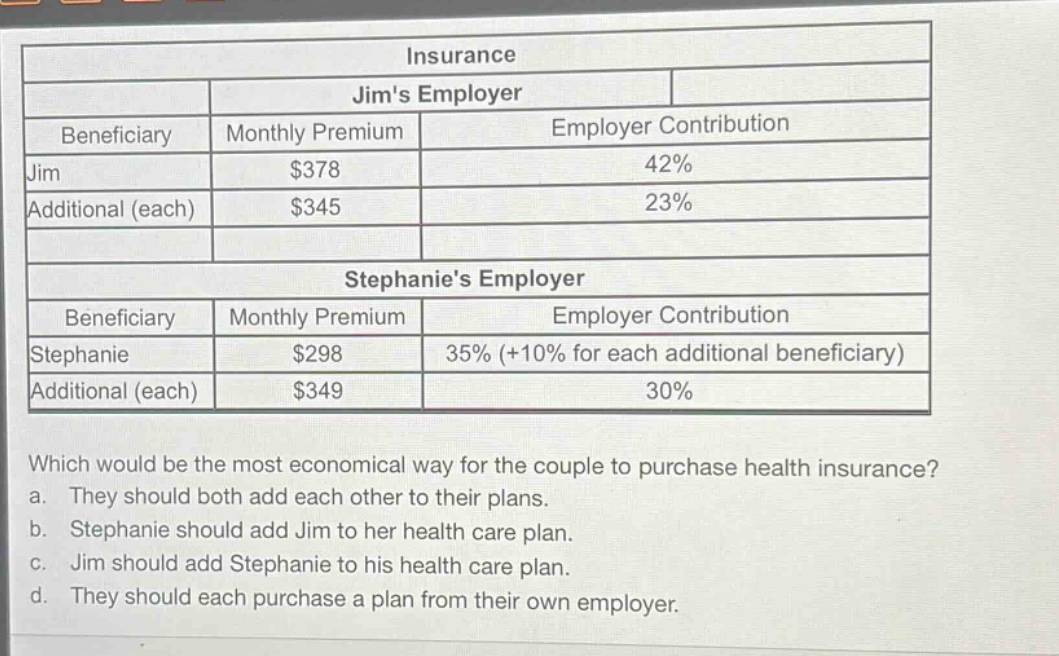
insurance\njims employer\nbeneficiary monthly premium employer contribution\njim $378 42%\nadditional (each) $345 23%\nstephanies employer\nbeneficiary monthly premium employer contribution\nstephanie $298 35% (+10% for each additional beneficiary)\nadditional (each) $349 30%\nwhich would be the most economical way for the couple to purchase health insurance?\na. they should both add each other to their plans.\nb. stephanie should add jim to her health care plan.\nc. jim should add stephanie to his health care plan.\nd. they should each purchase a plan from their own employer.
Answer
Explanation:
Step1: Calculate the cost if they each purchase a plan from their own employer (Option d).
Jim's cost = Monthly Premium $\times$ (1 - Employer Contribution %) = $$378 \times (1 - 0.42) = $378 \times 0.58 = $219.24$ Stephanie's cost = Monthly Premium $\times$ (1 - Employer Contribution %) = $$298 \times (1 - 0.35) = $298 \times 0.65 = $193.70$ Total Cost (Option d) = $$219.24 + $193.70 = $412.94$
Step2: Calculate the cost if Jim adds Stephanie to his health care plan (Option c).
Jim's cost for himself = $$378 \times (1 - 0.42) = $219.24$ Cost for adding Stephanie = Additional Premium $\times$ (1 - Employer Contribution % for additional) = $$345 \times (1 - 0.23) = $345 \times 0.77 = $265.65$ Total Cost (Option c) = $$219.24 + $265.65 = $484.89$
Step3: Calculate the cost if Stephanie adds Jim to her health care plan (Option b).
Stephanie's employer contribution increases by 10% for the additional beneficiary. Stephanie's cost for herself = Monthly Premium $\times$ (1 - (Employer Contribution % + Additional %)) = $$298 \times (1 - (0.35 + 0.10)) = $298 \times (1 - 0.45) = $298 \times 0.55 = $163.90$ Cost for adding Jim = Additional Premium $\times$ (1 - Employer Contribution % for additional) = $$349 \times (1 - 0.30) = $349 \times 0.70 = $244.30$ Total Cost (Option b) = $$163.90 + $244.30 = $408.20$
Step4: Compare the total costs for options b, c, and d.
Option b cost = $$408.20$ Option c cost = $$484.89$ Option d cost = $$412.94$ The lowest cost is $$408.20$, which corresponds to Option b. Option a (both adding each other) would result in double coverage and be significantly more expensive than the other options.
Answer:
b. Stephanie should add Jim to her health care plan.