jenny invests $2,000 at an interest rate of 5%. the amount of money, $m_a$, in jennys account after $t$…
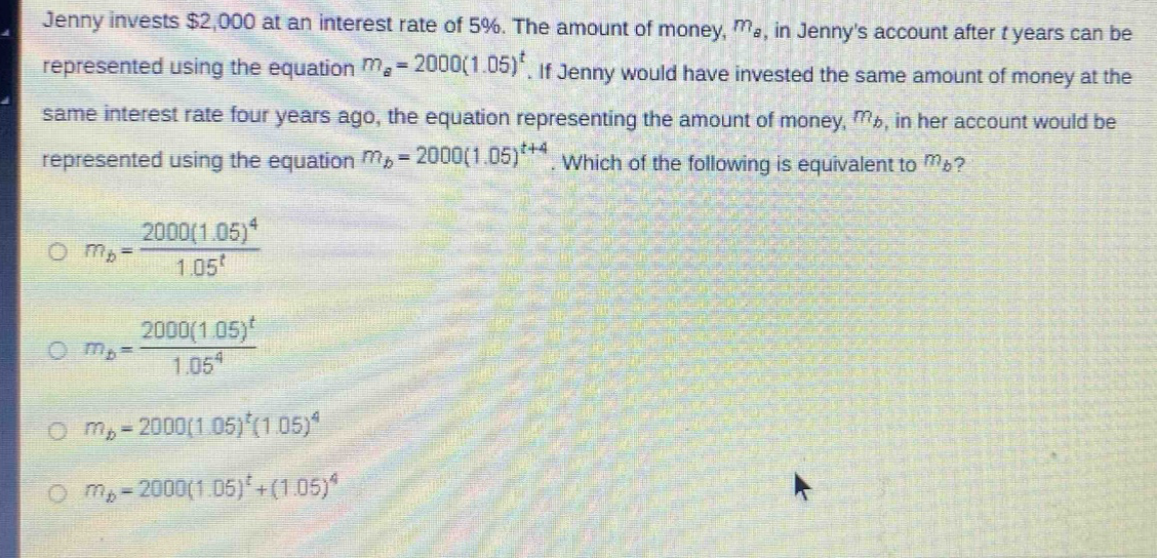
jenny invests $2,000 at an interest rate of 5%. the amount of money, $m_a$, in jennys account after $t$ years can be represented using the equation $m_a = 2000(1.05)^t$. if jenny would have invested the same amount of money at the same interest rate four years ago, the equation representing the amount of money, $m_b$, in her account would be represented using the equation $m_b = 2000(1.05)^{t + 4}$. which of the following is equivalent to $m_b$?\n$m_b=\frac{2000(1.05)^4}{1.05^t}$\n$m_b=\frac{2000(1.05)^t}{1.05^4}$\n$m_b = 2000(1.05)^t(1.05)^4$\n$m_b = 2000(1.05)^t+(1.05)^4$
Answer
Explanation:
Step1: Apply exponent - rule
Recall the rule $a^{m + n}=a^{m}\times a^{n}$. For the expression $m_b = 2000(1.05)^{t + 4}$, we can rewrite it using this rule. Here, $a = 1.05$, $m=t$, and $n = 4$. So, $m_b=2000\times(1.05)^{t}\times(1.05)^{4}$.
Answer:
$m_b = 2000(1.05)^{t}(1.05)^{4}$