josiah invests $360 into an account that accrues 3% interest annually. assuming no deposits or withdrawals…
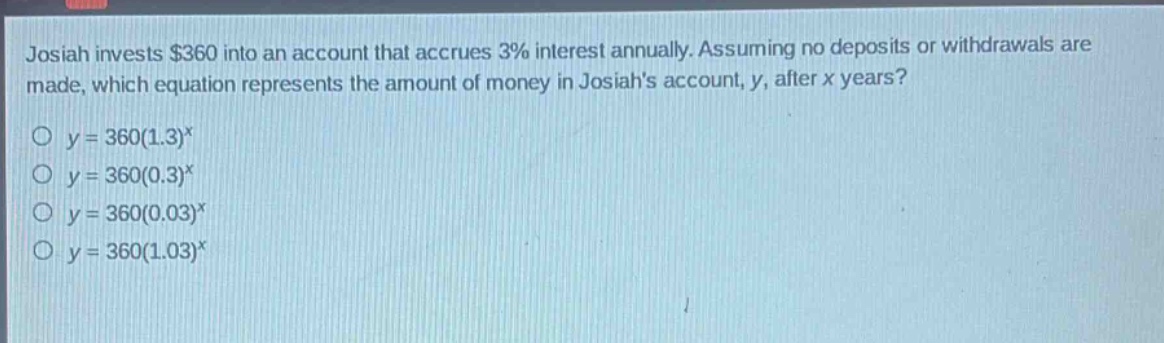
josiah invests $360 into an account that accrues 3% interest annually. assuming no deposits or withdrawals are made, which equation represents the amount of money in josiahs account, y, after x years?\no y = 360(1.3)^x\no y = 360(0.3)^x\no y = 360(0.03)^x\no y = 360(1.03)^x
Answer
Explanation:
Step1: Recall compound - interest formula
The compound - interest formula for an initial investment $P$ with an annual interest rate $r$ (as a decimal) compounded annually for $x$ years is $y = P(1 + r)^x$.
Step2: Identify values of $P$ and $r$
Here, $P=$360$ (the initial investment) and $r = 3%=0.03$ (the annual interest rate as a decimal).
Step3: Substitute values into formula
Substitute $P = 360$ and $r=0.03$ into $y = P(1 + r)^x$. We get $y = 360(1 + 0.03)^x=360(1.03)^x$.
Answer:
D. $y = 360(1.03)^x$