juana invests $1,500 in an account accumulating 3% interest according to the equation $v = 1500(1.03)^y$…
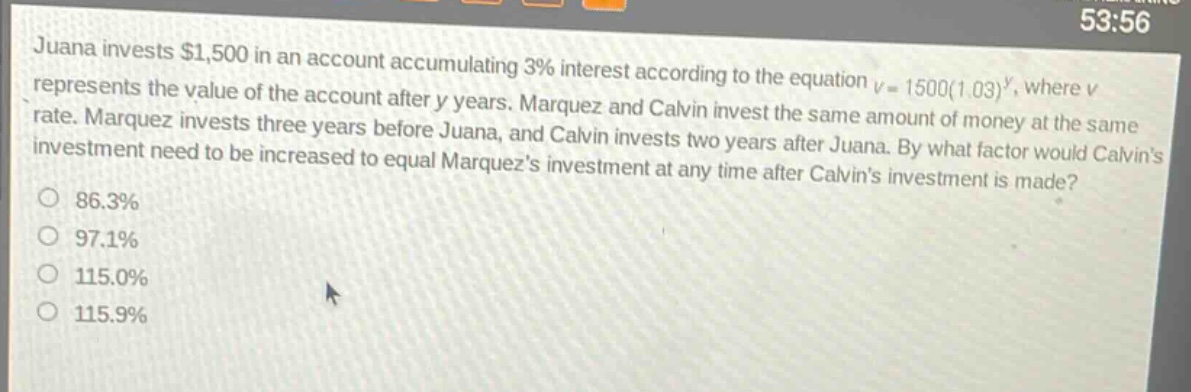
juana invests $1,500 in an account accumulating 3% interest according to the equation $v = 1500(1.03)^y$, where $v$ represents the value of the account after $y$ years. marquez and calvin invest the same amount of money at the same rate. marquez invests three years before juana, and calvin invests two years after juana. by what factor would calvins investment need to be increased to equal marquezs investment at any time after calvins investment is made?\n86.3%\n97.1%\n115.0%\n115.9%
Answer
Explanation:
Step1: Define the investment functions
Let $y$ be the number of years since Juana's investment. Marquez invests 3 years before Juana, so the value of Marquez's investment $M = 1500(1.03)^{y + 3}$. Calvin invests 2 years after Juana, so the value of Calvin's investment $C=1500(1.03)^{y - 2}$.
Step2: Find the factor
We want to find the factor $x$ such that $C\times x = M$. Substitute the expressions for $M$ and $C$: [1500(1.03)^{y - 2}\times x=1500(1.03)^{y + 3}] Divide both sides by $1500(1.03)^{y - 2}$: [x=\frac{1500(1.03)^{y + 3}}{1500(1.03)^{y - 2}}] Using the rule of exponents $\frac{a^m}{a^n}=a^{m - n}$, we have $x=(1.03)^{(y + 3)-(y - 2)}=(1.03)^{5}$. [x = 1.03^5=1.159274\approx115.9%]
Answer:
115.9%