julia is offered a job selling advertising for two different companies. company a offers a base salary of…
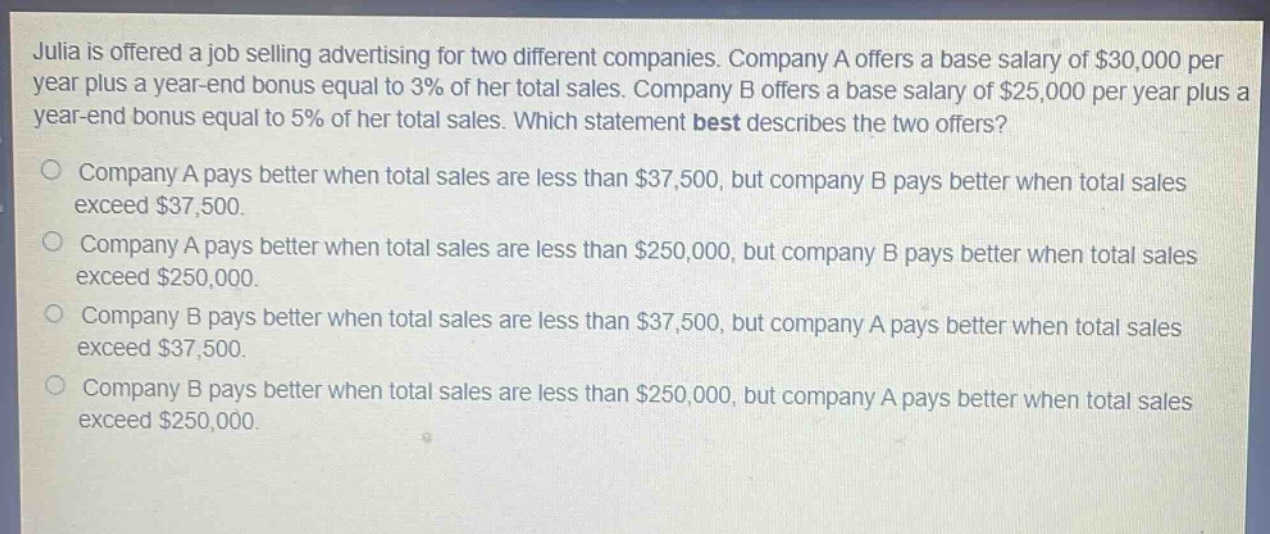
julia is offered a job selling advertising for two different companies. company a offers a base salary of $30,000 per year plus a year - end bonus equal to 3% of her total sales. company b offers a base salary of $25,000 per year plus a year - end bonus equal to 5% of her total sales. which statement best describes the two offers? company a pays better when total sales are less than $37,500, but company b pays better when total sales exceed $37,500. company a pays better when total sales are less than $250,000, but company b pays better when total sales exceed $250,000. company b pays better when total sales are less than $37,500, but company a pays better when total sales exceed $37,500. company b pays better when total sales are less than $250,000, but company a pays better when total sales exceed $250,000.
Answer
Explanation:
Step1: Set up equations
Let ( x ) be the total sales. For Company A, the total pay ( y_A=30000 + 0.03x ). For Company B, the total pay ( y_B = 25000+0.05x ).
Step2: Find when ( y_A=y_B )
Set ( 30000 + 0.03x=25000+0.05x ). Subtract ( 0.03x ) from both sides: ( 30000=25000 + 0.02x ). Subtract ( 25000 ) from both sides: ( 5000=0.02x ). Solve for ( x ): ( x=\frac{5000}{0.02}=250000 ).
Step3: Analyze the two - pay functions
If ( x < 250000 ), let ( x = 0 ). Then ( y_A=30000 ) and ( y_B=25000 ), ( y_A>y_B ). If ( x>250000 ), let ( x = 300000 ). Then ( y_A=30000+0.03\times300000=30000 + 9000=39000 ), ( y_B=25000+0.05\times300000=25000 + 15000=40000 ), ( y_B>y_A ).
Answer:
Company A pays better when total sales are less than ( $250,000 ), but company B pays better when total sales exceed ( $250,000 ). So the second option is correct.