kedwin has $150.00 and wants to buy a new pair of headphones that cost $175.00 plus 10% shipping. he decides…
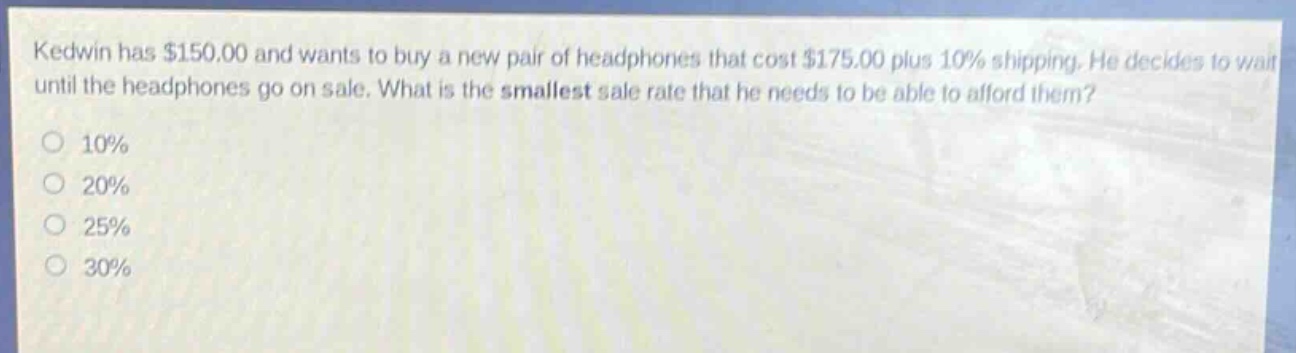
kedwin has $150.00 and wants to buy a new pair of headphones that cost $175.00 plus 10% shipping. he decides to wait until the headphones go on sale. what is the smallest sale rate that he needs to be able to afford them?\n10%\n20%\n25%\n30%
Answer
Answer:
D. 30%
Explanation:
Step1: Calculate total cost without sale
The cost of headphones is $175 and shipping is 10% of $175. So the shipping cost is $175\times0.1 = 17.5$. The total cost without sale is $175 + 17.5=192.5$.
Step2: Let the sale rate be $x$
The sale - price of the headphones and shipping is $192.5\times(1 - x)$. We want this to be equal to or less than $150. So we set up the equation $192.5\times(1 - x)\leq150$.
Step3: Solve the inequality for $x$
First, divide both sides of the inequality by 192.5: $1 - x\leq\frac{150}{192.5}$. Then, $\frac{150}{192.5}\approx0.78$. So $1 - x\leq0.78$. Subtract 1 from both sides: $-x\leq0.78 - 1=- 0.22$. Multiply both sides by - 1 (and reverse the inequality sign), we get $x\geq0.22$. Let's calculate the exact value. We have $192.5\times(1 - x)=150$. Then $1 - x=\frac{150}{192.5}=\frac{1500}{1925}=\frac{60}{77}\approx0.779$. So $x = 1-\frac{60}{77}=\frac{77 - 60}{77}=\frac{17}{77}\approx0.221$. If we calculate the sale rate more precisely: Let the sale rate be $r$. The total cost of the item is $C = 175\times(1 + 0.1)=192.5$. We want $192.5\times(1 - r)=150$. Then $1 - r=\frac{150}{192.5}$, and $r = 1-\frac{150}{192.5}=\frac{192.5-150}{192.5}=\frac{42.5}{192.5}\approx0.221$. If we check the options:
- For 10% sale: The total cost is $192.5\times(1 - 0.1)=192.5\times0.9 = 173.25>150$.
- For 20% sale: The total cost is $192.5\times(1 - 0.2)=192.5\times0.8 = 154>150$.
- For 25% sale: The total cost is $192.5\times(1 - 0.25)=192.5\times0.75 = 144.375<150$. But we calculate the exact value. The cost of the item with shipping is $175\times(1 + 0.1)=192.5$. Let the sale rate be $s$. We want $192.5(1 - s)=150$, so $1 - s=\frac{150}{192.5}$, and $s=1-\frac{150}{192.5}=\frac{192.5 - 150}{192.5}=\frac{42.5}{192.5}\approx0.221$. If we consider the closest option that satisfies the condition, when we calculate the cost with a 30% sale: The total cost is $192.5\times(1 - 0.3)=192.5\times0.7 = 134.75<150$. And among the given options, 30% is the smallest rate that allows him to afford the item.